After what has unarguably been a long winter, summer weather has finally arrived in Maine. Over the course of the past year, you may have been approached in person or by phone/email by Maine Department of Marine Resources (ME DMR) staff regarding your participation in NOAA Fisheries’ Marine Recreational Information Program (MRIP) national network of recreational fishing surveys. This newsletter provides insight on the work conducted by Maine DMR and shares a few summaries from the 2025 season. Monitoring catch, effort, and participation in saltwater recreational fishing, along with demographic, social, and economic characteristics of those who participate, allows for monitoring trends, evaluating the effects of fishing regulations, and projecting what impacts various management scenarios will have on marine fisheries. Your participation in these survey programs provide the invaluable data upon which the management of our fisheries depends. To those of you who participated last season, we extend our gratitude for your contribution to bettering the estimates of Maine’s recreational catch and effort.
- ME DMR Recreational Fisheries Program staff
In this issue:
- MRIP Survey Information
- Large Pelagic Survey Information
- Data Collection Results
- Volunteer Angler Logbook Program
- Maine Tacklebusters Club
- Saltwater Spearfishing FAQ
- Striped Bass Research
- Bluefish Research
Maine Recreational Information Program (MRIP)
Access Point Angler Intercept Survey (APAIS)
A voluntary survey of marine recreational anglers at the end of their fishing trip, with a focus on gathering information about catch, participation and fishing effort. Interviewers are assigned to pre-selected coastal fishing access locations for various time blocks, seven days a week during the sampling season. Head boat anglers are surveyed during their trip by ride-along interviewers, allowing direct collection of discard data as well as harvest data.
Conducted by ME DMR on behalf of NOAA Fisheries, May through October in Maine.
Fishing Effort Survey (FES)
Households are sampled from a national database of mailing addresses, which is supplemented with information from state-based recreational fishing license and registration programs. Because research indicates that both anglers and non-anglers are more likely to respond to a survey that includes questions about topics other than fishing, the FES is designed as a weather and outdoor activity survey. This helps improve the number of responses received while reducing the risk of nonresponse bias.
Conducted by an outside NOAA Fisheries contractor.
For-Hire Telephone Survey (FHTS)
Begun in 2008 as part of the MRIP, the voluntary FHTS collects fishing effort data from the for-hire fishing fleet (charter and head/party boats). A randomly chosen 10% of for-hire vessels are surveyed weekly from a coast-wide directory of eligible vessels, and Captains are asked to report trip & fishing effort information for the previous week. FHTS effort data is combined with APAIS data of for-hire fishing anglers to produce estimates of catch per trip by area for the for-hire fleet.
Conducted by ME DMR on behalf of NOAA Fisheries, May through October in Maine.
Large Pelagic Survey (LPS)
Large Pelagic Intercept Survey (LPIS)
A dockside survey of private and charter boats that have just completed fishing trips directed at large pelagic species. This survey is conducted at public fishing access sites that are likely to be used by offshore anglers and is primarily designed to collect detailed catch data.
Conducted by ME DMR on behalf of NOAA Fisheries, July through October.
Large Pelagic Telephone Survey (LPTS)
A telephone survey in which a randomly chosen 10% of the federally permitted HMS fleet is contacted weekly and captains are asked to report detailed trip, fishing effort, & catch information for the previous week.
Conducted by ME DMR on behalf of NOAA Fisheries, June through October for boats with CH/HB HMS permit. ME boats holding other HMS category permits are surveyed by an outside NOAA Fisheries contractor.
* Due to overlap of eligible vessels between LPTS and FHTS, the two surveys are conducted in tandem.
For additional information about MRIP surveys and Highly Migratory Species management information, visit the following NOAA Fisheries websites: MRIP - https://www.fisheries.noaa.gov/topic/recreational-fishing-data, HMS - www.fisheries.noaa.gov/topic/atlantic-highly-migratory-species.
Data Collection Results
APAIS/LPS
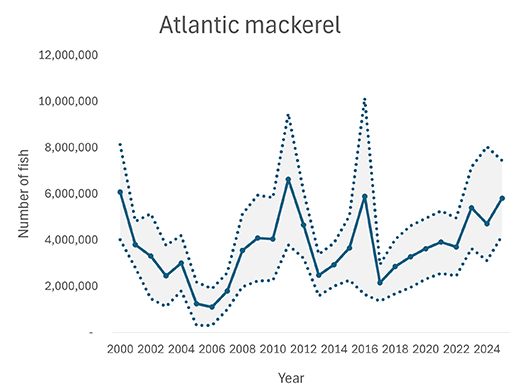
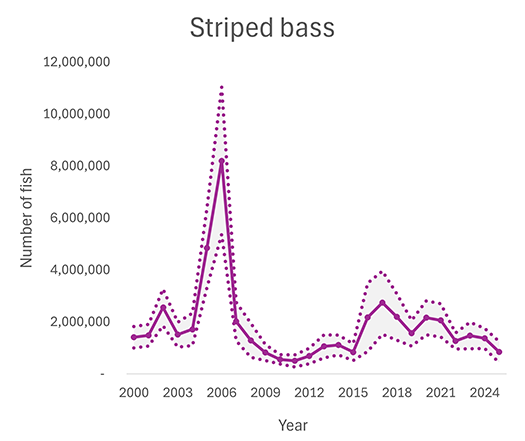
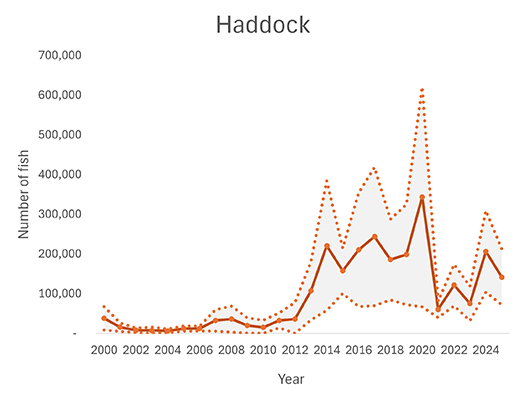
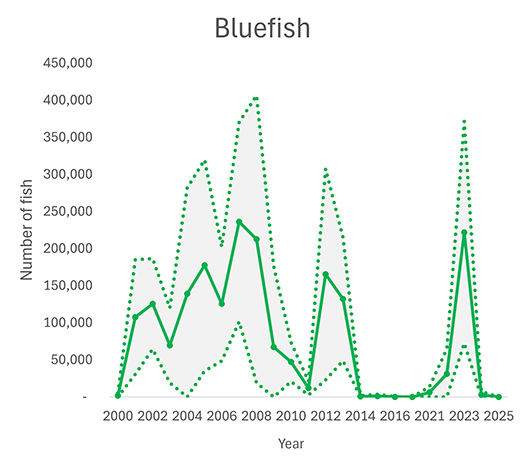
The table below indicates the number of anglers interviewed for APAIS and LPS throughout the 2025 season. The graphs show recreational fishing estimates for a few key species created from the data contributed by anglers in Maine.
|
|
May |
June |
July |
August |
September |
October |
Total |
|---|---|---|---|---|---|---|---|
|
Charter boat anglers |
1 |
19 |
78 |
36 |
27 |
4 |
165 |
|
Head boat anglers |
5 |
9 |
- |
- |
- |
- |
14 |
|
Private boat anglers |
64 |
210 |
269 |
144 |
82 |
5 |
774 |
|
Shore anglers |
120 |
53 |
167 |
103 |
45 |
8 |
496 |
|
LPS interviews (traditional and pilot surveys) |
LPS survey starts in July |
25 |
15 |
25 |
5 |
70 |
|
Maine's Total Recreational Catch Estimates (2000-2025)
Volunteer Angler Logbook Program
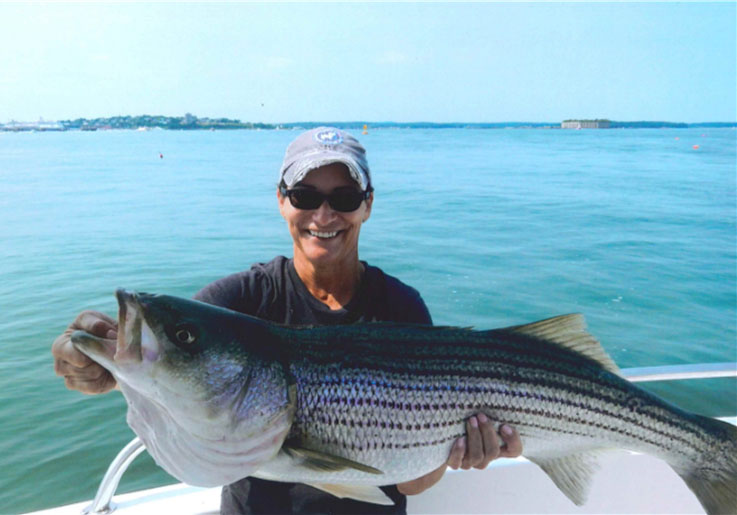
The Volunteer Angler Logbook (VAL) program is primarily geared toward striped bass anglers, but it is open to anglers who fish for any saltwater species. The primary goal of the survey is to collect additional length, catch & effort data for striped bass. Indeed, our field staff sees a limited number of these fish each season due to size and bag limits for this species as well anglers opting for catch and release.
The VAL program is quite simple. An angler records information about fish harvested or released during each trip for themselves and any fishing companions, even if no fish were caught! The logbook is available in paper or electronic format. Please email chris.b.uraneck@maine.gov if you would like to learn more or sign up.
Preliminary summary of the 2025 data:
Effort data: The 39 logbook keepers reported 603 fishing trips which, when multiplied by the number of logbook keepers and their fishing companions, resulted in 897 individual angler-trips. The 39 logbook keepers reported that they and their fishing companions fished over 2,700 angler-hours over the course of the season. Of the 897 individual angler-trips, 89% (797) targeted striped bass as the primary or secondary target species. 59 fishing trips reported using a tube rig set up, 48 of which caught striped bass (81%).
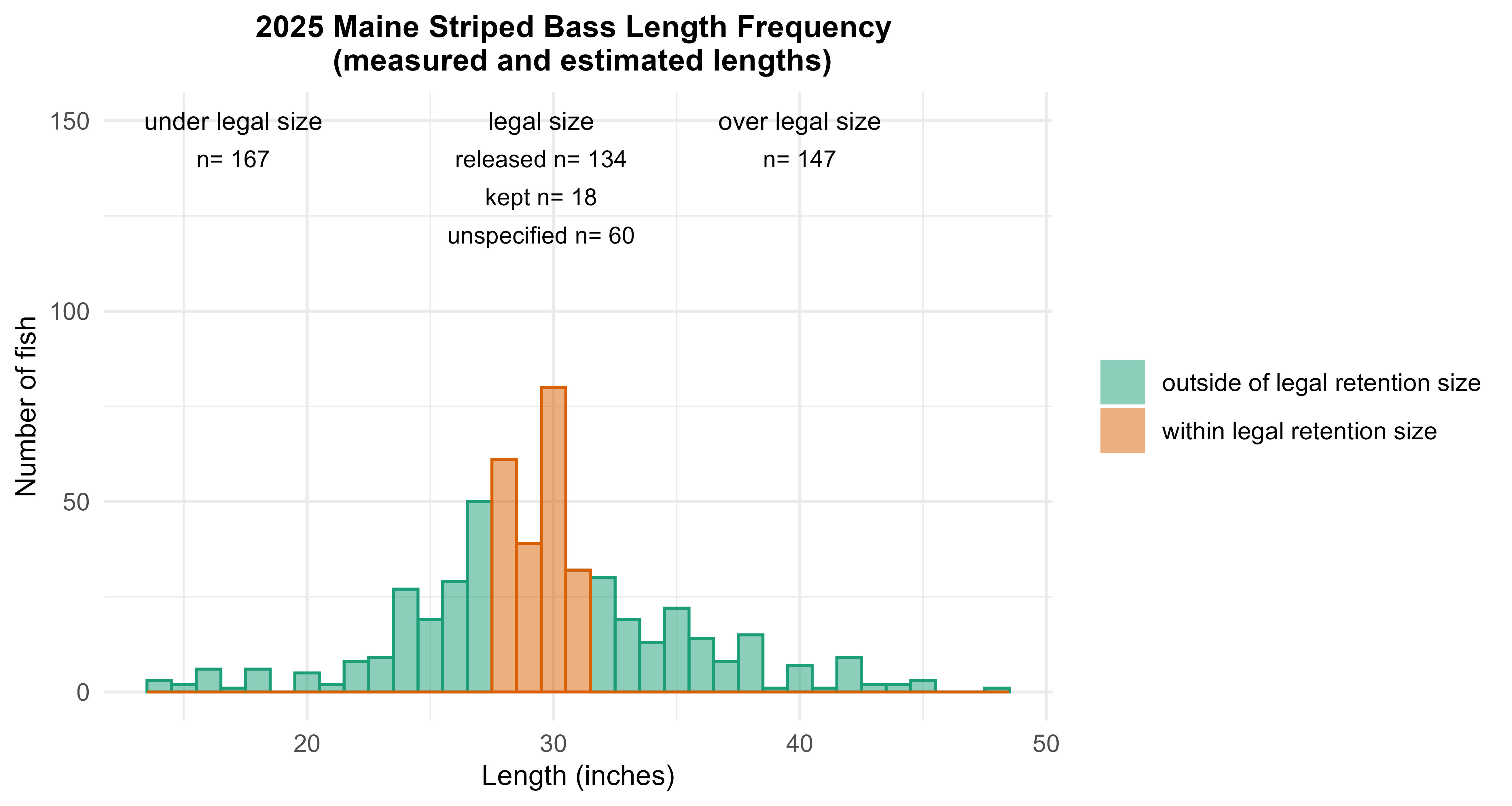
Catch data – striped bass: The catch rate for striped bass was about 0.16 sb/angler-hour on all trips with complete catch information (number of anglers and hours fishing) targeting striped bass as the primary or secondary target (797 angler-trips). In 2024, the rate was 0.45 sb/angler-hour. A total of 526 striped bass were caught on 248 trips. The highest total was in 2005 when 28,476 striped bass were caught on 2,203 trips. Of the 526 striped bass caught in 2025, 3.4% (18) were kept and 85.2% (448) were released. 11.4% (60 striped bass) were unspecified whether they were kept or released.
Length data – striped bass: All 526 striped bass had their length either estimated or measured.
40.3% (212) of the stripers (using both estimated and measured lengths) were between 28” and 31” (legal retention size). Of these, 9% (18) were kept, 63% (134) were released and 28% (60) were unspecified whether kept or released. 59.7% (314) of the striped bass with estimated or measured lengths were not of legal retention size. The average size for measured striped bass was 29.5”. The largest fish was 48” and the smallest was 14”.
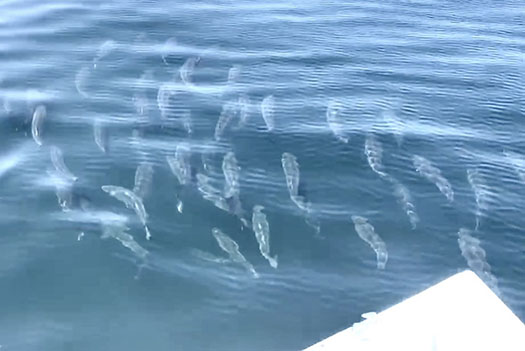
 This "club" is an association of saltwater anglers who have landed a "BIG ONE" in Maine. Tackle Busters was established as a way to recognize saltwater anglers who have outstanding catches of particular fish, but do not qualify for state record. Anglers who wish to qualify for Tackle Busters but wish to release their fish unharmed may do so if the fish meets the following minimum total length requirement.
|
Fish Species |
Minimum Requirements |
|
Black Sea Bass |
2 pounds |
|
Bluefin Tuna |
300 pounds |
|
Bluefish |
15 pounds or 36 inches |
|
Cusk |
12 pounds |
|
Haddock |
7 pounds |
|
Halibut |
50 pounds |
|
Mackerel |
2 pounds |
|
Monkfish |
20 pounds |
|
Pollock |
25 pounds |
|
Porbeagle Shark |
200 pounds |
|
Shad |
21 inches |
|
Striped Bass |
25 pounds or 42 inches |
|
Tautog |
3 pounds |
|
Thresher Shark |
200 pounds |
|
White Hake |
25 pounds |
|
Whiting (Silver Hake) |
3 pounds |
|
Winter Flounder |
2 pounds |
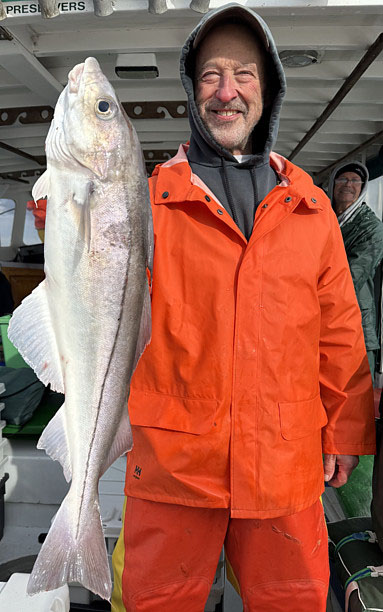
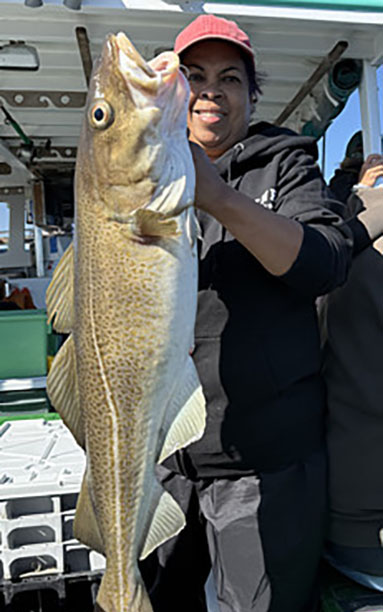
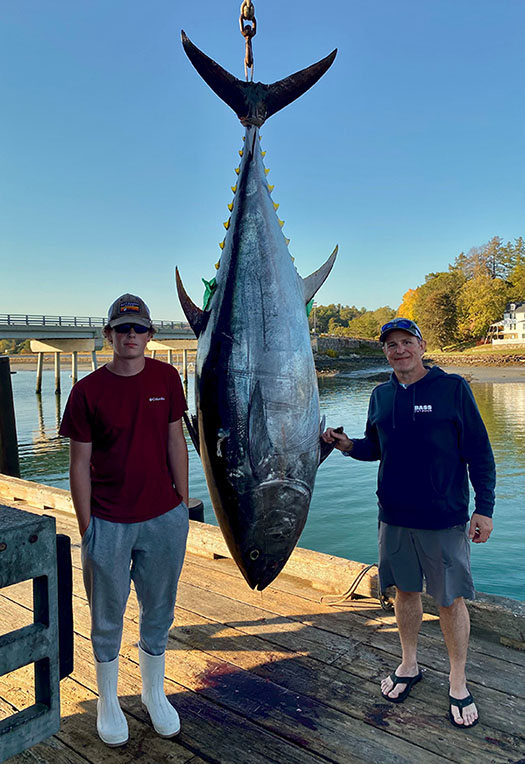
Largest Fish in Each Category
|
Species |
# of Entries |
Weight (lbs.) |
Length (in.) |
Angler |
Date |
|
Acadian Redfish |
8 |
3 |
17 |
Boo Whitten |
9/2/2025 |
|
Bluefin Tuna |
1 |
396 |
97 |
Joel Charron |
10/5/2025 |
|
Cusk |
18 |
32.5 |
42.5 |
Chris Cicho |
7/22/205 |
|
Haddock |
30 |
9 |
29 |
Karl Day |
5/29/2025 |
|
Halibut |
6 |
76 |
54 |
Troy Galloway |
4/15/2025 |
|
White Hake |
10 |
50 |
50 |
Roger Gavin |
7/8/2025 |
|
Whiting (Silver Hake) |
4 |
3.75 |
24 |
Raymond Hickman |
9/25/2025 |
Maine Saltwater Spearfishing Frequently Asked Questions
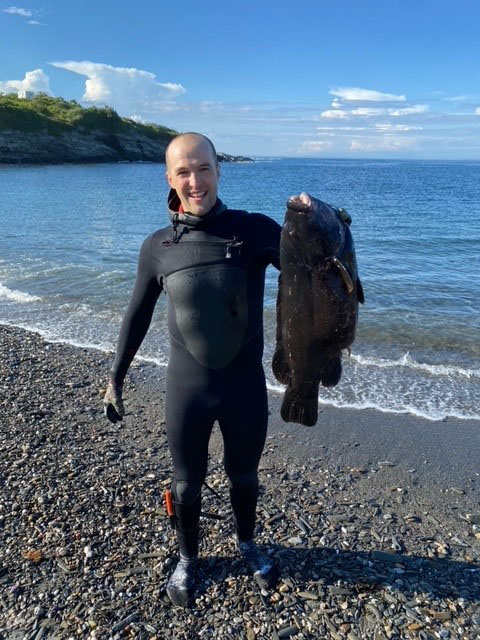
In recent years the Maine DMR has been getting increased questions about recreational spearfishing in Maine’s territorial waters. These are some frequently asked questions and answers regarding spearfishing in saltwater in Maine:
- Is spearfishing allowed in Maine?
Yes, but there are regulations for certain species.
- Which species are you allowed to spearfish for?
Winter flounder, summer flounder, cunner, tautog, haddock, Atlantic cod, pollock, bluefish and Atlantic menhaden (Note: size, bag limits and other restrictions may apply. Please see the species regulations section or printable regulation sheets).
- Which species are you not allowed to spearfish for?
Striped bass, black sea bass, Atlantic halibut, Atlantic sturgeon, shortnose sturgeon, Atlantic salmon, American shad and American lobster.
Note these regulations are subject to change. Please check with your local Marine Patrol Officer if you have any additional questions.
Don’t Toss It — Donate It!
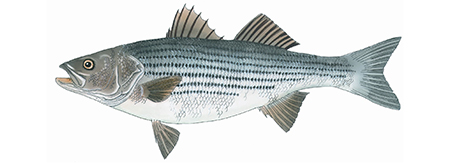
Save Your Striped Bass Racks for Research
The UMaine Research Team Wants To Sample Your Striped Bass for Science!
You can help them understand what striped bass are eating in Maine
YOU KEEP THE FILLETS — THEY JUST NEED THE REST!
HOW TO DONATE A FISH:
- Catch a legal striped bass (28–31” Total Length)
- Fillet your fish — keep the meat!
- Put filleted rack in plastic bag and keep on ice/freeze
- Label a tag with catch DATE and LOCATION and put in bag
- Drop off at donation site or contact us for pickup
Drop off Locations
- Saco Bay Tackle Shop; Saco, ME
- Webhannet River Boatyard; Wells, ME
- Fishermens Edge; Edgecomb, ME
- Darling Marine Center; Damariscotta, ME
- OR Text/Call: 401-651-1034 to arrange pickup!
WHY IT MATTERS?
This is the first coastwide study to document what striped bass are eating in Maine waters. Your donation helps provide information that fisheries managers can use to manage predator and prey species together — helping support a healthy striped bass fishery for the future. Don’t miss out on this opportunity to be a part of a local cooperative research project!
Contact: Abby Remick: 401-651-1034 - abrielle.remick@maine.edu
Learn more about the UMaine Striped Bass Foraging Ecology Study
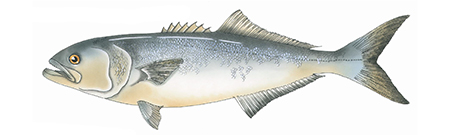
Catch Bluefish?
Help Study Global Distribution
Maine DMR needs your contributing to a worldwide study of bluefish genetics.
Catch a bluefish and want to participate? Follow these steps!
Please clip a small piece about the size of a large fingernail from the dorsal (top) or tail fin before release
Store the sample in your cooler
Call or text our sampler Declan at 207-707-2498 to collect your sample.