The Maine Coastal Program has moved to the new Maine Office of Community Affairs (MOCA). Please refer to the MOCA website for all information about Maine Coastal Program.
FY2027 Grant Program
FY27 Program Statement
FY27 Questions received and answers (to be posted periodically until August 21, 2026)
The Maine Office of Community Affairs’ Maine Coastal Program (MCP) and Municipal Planning Assistance Program (MPAP) are seeking applications for coastal planning grants totaling approximately $450,000. The two grants covered by this announcement are the Shore and Harbor Planning Grant and the Coastal Community Grant. Funding for these planning grants comes from the Maine Coastal Program’s annual grant from the National Oceanic and Atmospheric Administration (NOAA).
Applications are due by 11:59 p.m. on Monday, August 31, 2026. All applications must be submitted using the MOCA grant portal (Submittable).
All questions or other communication regarding this program statement must be sent to Melissa Britsch, Marine Resource Management Coordinator at Maine Coastal Program, at mainecoastalprogram@maine.gov. Any responses deemed substantive and binding will be summarized and posted on the Maine Coastal Program and Municipal Planning Assistance Program websites on a rolling basis until August 21, 2026.
Eligibility & Priority Categories
Eligible applicants include municipalities, unorganized townships, and Tribal Governments in Maine’s Coastal Zone, as well as coastal Regional Councils. Coastal Regional Councils may submit applications on behalf of coastal municipalities, townships, or Tribal Governments. Projects that include partnerships are strongly encouraged, and collaborative projects are eligible for a higher maximum award amount (See section 1.2).
Maine Coastal Program and the Municipal Planning Assistance Program plan to allocate a total of approximately $450,000 during this grant round. For single applicants, the maximum award is $50,000 and the minimum award is $5,000; applicants may submit more than one application if the projects fall into distinct priority categories. Groups of eligible applicants (e.g., two municipalities) may submit applications for collaborative projects with a maximum award amount of $75,000. Grants are anticipated to be awarded in October 2026, with an expected start date in December 2026. As these are federal funds, the grant contracts cannot be executed, and projects cannot start until the completion of NOAA's review of the proposed projects. Projects must be completed, and deliverables received by March 31, 2028.
The FY26 grants will provide resources on a competitive basis for planning projects that fall into the following Priority Categories:
- Conduct an assessment of the long-term hazards and risks from changing ocean conditions, storm surge, and flooding either community-wide or at critical public infrastructure, such as at boat launches, lifeline roads, etc. Collaborative projects that address regional hazards are encouraged.
- Design and create plans for resilient infrastructure either community-wide or at critical public facilities, such as at boat launches, lifeline roads, etc.
- Conduct needs assessments for use of and access to public waterfront facilities, and develop harbor management plans, regulatory and non-regulatory approaches to waterfront development, mooring plans, inventories of public water access points, or plans to improve access over time. Collaborative projects that address regional needs are encouraged.
- Legal work to identify lost or contested public rights-of-way to coastal waters, such as beaches or intertidal mudflats.
- Identify hazard-prone locations to integrate land conservation and public access planning, guiding development away from sensitive areas. This could include low impact development, resilient land use planning, coastal resource conservation, and planning for nature-based projects like living shorelines to manage the impacts of increased precipitation and stormwater, as well as beach, dune, marsh or bluff erosion. Collaborative projects that address regional needs are encouraged.
- Regulatory and non-regulatory land use planning to ensure community resilience to current and future coastal hazards like flooding, shoreline erosion, and coastal storms and storm surge. These planning efforts could include changes to municipal land use regulations, conservation plans to reconnect floodplains, allowances for salt marsh migration, identification of living shoreline protection areas, and completion of the Maine Flood Resilience Checklist. Collaborative projects that address regional needs are encouraged.
- Reduce water quality impacts from polluted runoff in Non-Point Source Priority Watersheds listed by the Maine Department of Environmental Protection as Impaired or Threatened Marine Waters or Impaired or Threatened Streams with emphasis on shellfish growing areas.
Program Goals
The Shore and Harbor Planning Grant program provides resources on a competitive basis for shoreline access planning, waterfront and harbor planning, identification and resolution of waterfront use conflicts, and planning, feasibility, and design efforts for resilient waterfront infrastructure. Shore and Harbor Planning Grant projects are often well prepared to compete for construction funding through other sources.
For an example of a vulnerability assessment and resilience planning project for working waterfront infrastructure, see the Penobscot Bay Vulnerability Assessment and Resilience Planning Draft Summary report at: Publications | Department of Marine Resources (maine.gov).
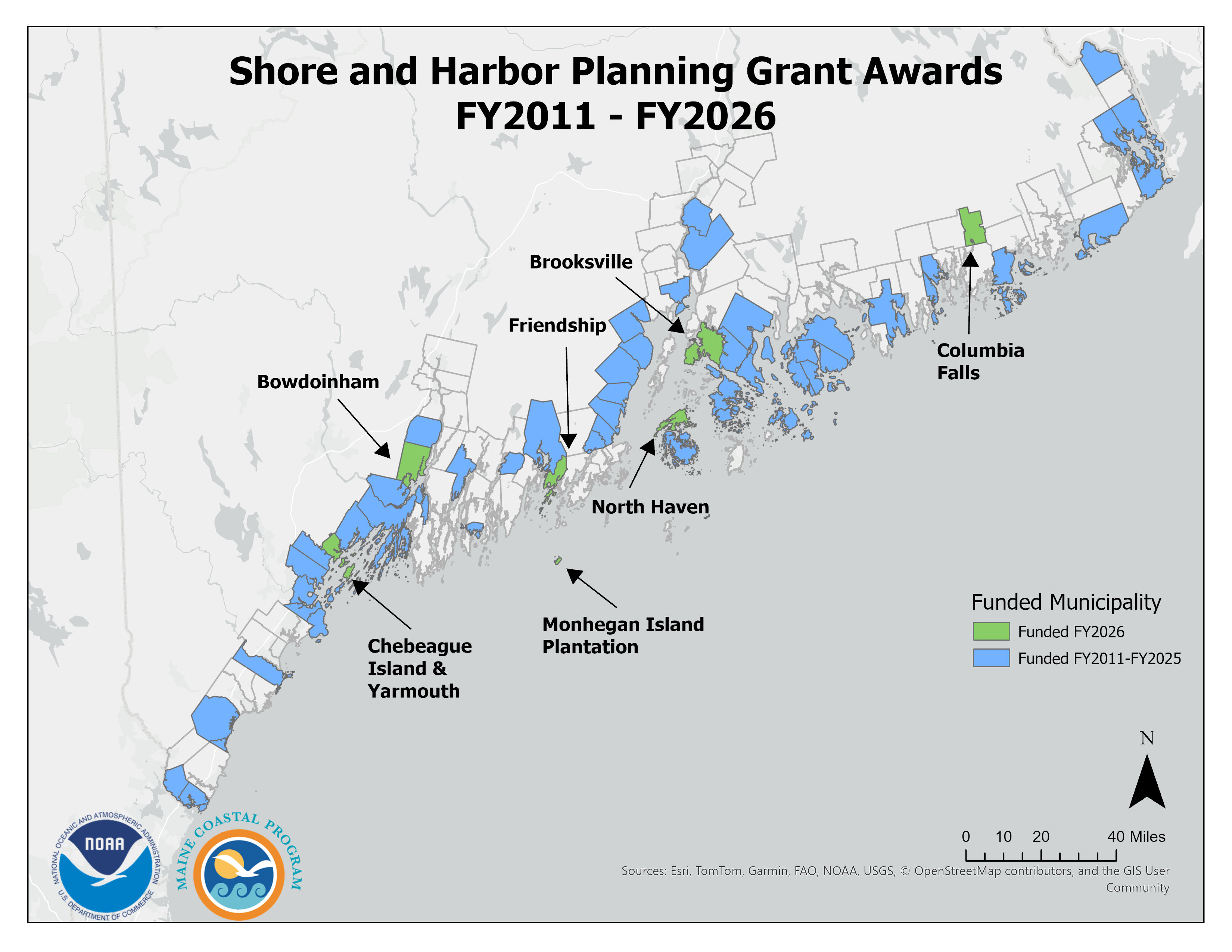
FY 2026 Grantees
- Bowdoinham: Waterfront Access & Resilience Planning
- Brooksville: Design and Engineering for new pier and floats at Betsy’s Cove
- Chebeague Island & Yarmouth: Resiliency Assessment and Conceptual Design, Cousins Island Wharf and Blanchard Lot
- Columbia Falls: Town Landing Design and Engineering
- Friendship: Final Design for Resilient Reconstruction of the Friendship Municipal Wharf
- Monhegan Island: Breakwater Resiliency Improvements
- North Haven: Engineering and Design of a Climate Resilient Working Waterfront and Fishermen's Wharf in Pulpit Harbor
Example Projects, Maps, and Funding Summary
Example projects and additional information about funded projects starting in Fiscal Year 2011
Map of funded towns
Link to the Maine Coastal Planning Grant Viewer
More Information
- This technical assistance program has been in continuous operation since 2000.
- For more information, please contact Melissa Britsch.