Salmo salar
Biology
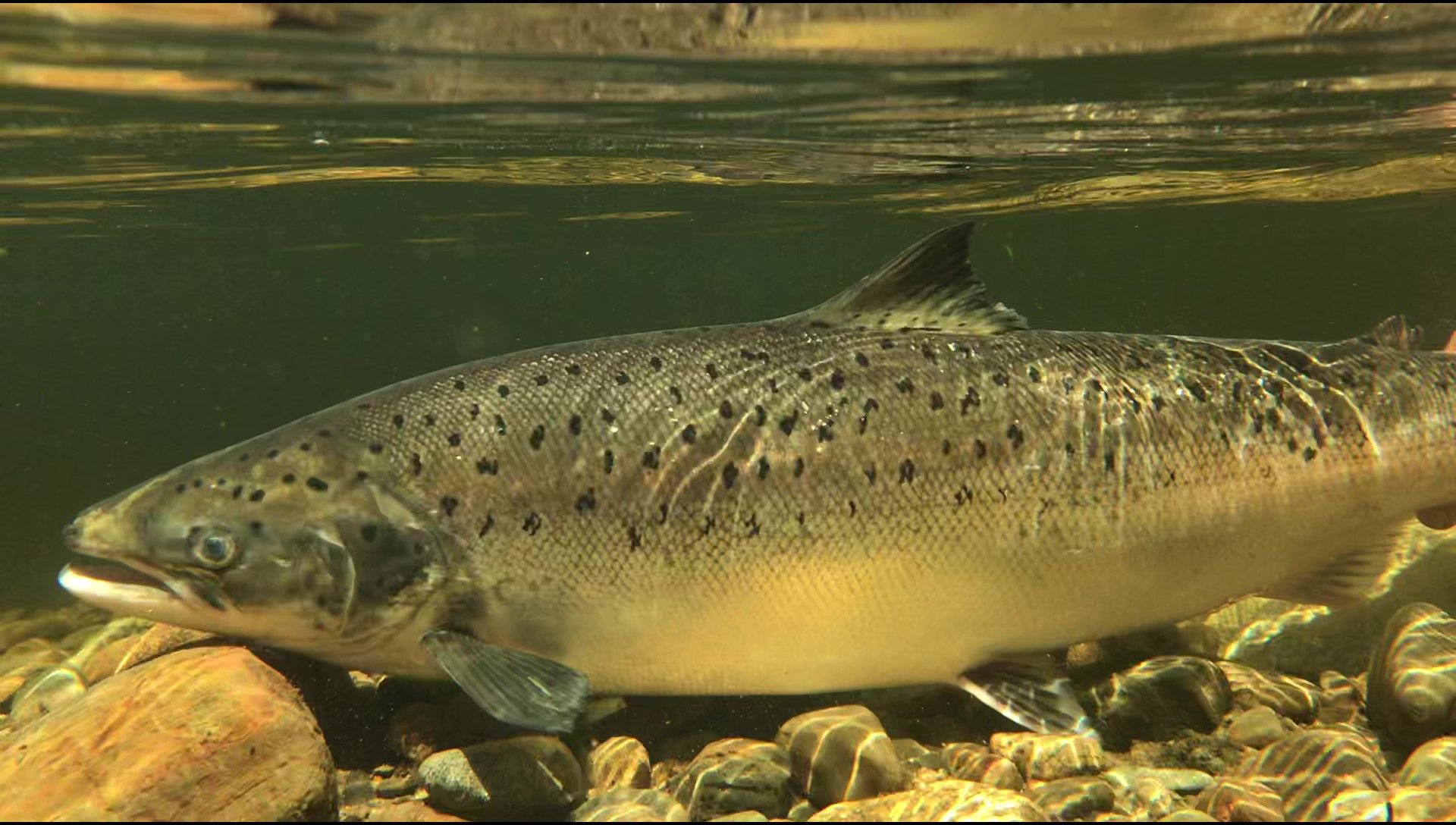
Sea-run Atlantic Salmon start their lives as eggs buried in clean, well-oxygenated gravel and cobble of Maine’s rivers and streams. Adult females dig nests, called “redds” in the fall, starting when water temperatures fall below 50F/10C. While the female digs with her tail, males compete for the prime position right by her side so they can fertilize her eggs.
The eggs incubate in the redd all winter, and hatch in the spring.
-
“Alevins” are tiny salmon that feed off a yolk sac before they emerge from the gravel nests.
-
“Fry” are the free swimming stage that emerge from the grave. They feed on small invertebrates drifting down stream.
-
“Parr” are young salmon and make up the longest stage in freshwater, typically lasting from 2-3 years, but as long as four years. Parr have circularly “parr marks” that helps them blend into the gravel.
-
“Smolt” undergo a complex physiological transition that prepares their bodies to migrate downstream to the ocean between mid-April and early June. The peak of smolt migration happens when water temperatures are around 50F/10C.
-
"Kelt" are adult salmon that have spawned. They may migrate back to the ocean after spawning or over-winter in freshwater lakes and return to the sea the following spring.
Once in the Gulf of Maine, salmon smolts migrate quickly to distant feeding grounds off Labrador and Greenland, where they spend one to three years before making a return migration to the rivers of their birth.
Returning adult salmon enter rivers and streams, mostly in the spring and summer, with a few fall migrants. As soon as they enter rivers, they stop feeding and find shaded, cool pools and springs to wait until water temperatures drop to 60-65F/15-18C. Once the water is cool enough, they disperse to spawning grounds to start the cycle over again.
Like American Shad and river herring, Atlantic salmon are iteroparous, which means if they survive spawning the first time they can return to spawn again another year. Repeat spawners were once common in Maine rivers but are now very rare.
Status and Management
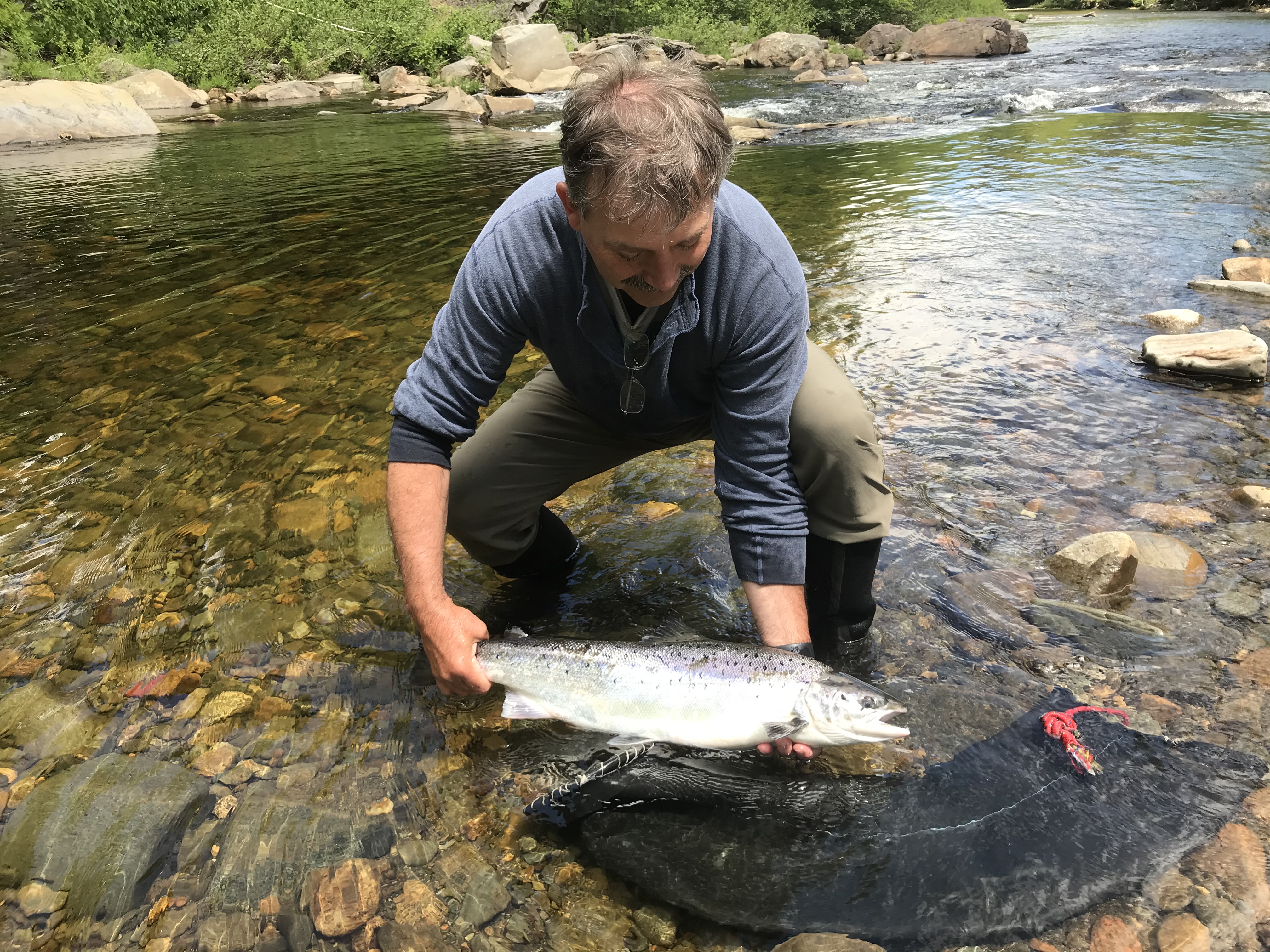
Before the Civil War 100,000 Atlantic salmon returned annually to the Penobscot River alone (Foster and Atkins 1867). But dams, log drives, pollution, and overfishing combined to bring Atlantic salmon to the brink of extinction throughout their U.S. range. In fact, by 1865 there were no Atlantic Salmon left in southern New England (Fay et al. 2006).
Today, the only remaining naturally spawning Atlantic salmon in the United States return to just eight rivers in the Gulf of Maine: The Sheepscot River, Sandy River in the Kennebec drainage, Ducktrap, Penobscot, Union, Narraguagus, Machias, East Machias River, and Dennys River. These rivers and the salmon that use them make up the Gulf of Maine Distinct Population Segment (DPS), which has been listed as Endangered under the US Endangered Species Act since 2000. Because of their endangered status it is illegal to fish for Sea-Run Atlantic Salmon.
Habitat loss and degradation in streams and rivers because of dams, poor road stream crossings, and stream habitat damage from logging pose substantial challenges to Atlantic Salmon, as does poor survival at sea and loss of genetic diversity.
Scientists and managers in the Bureau of Sea-Run Fisheries and Habitat are working alongside partners to prevent extinction through the conservation hatchery program, improving access to spawning and rearing habitat by improving passage through dams and culverts, and making habitat more suitable for salmon reproduction and growth.
Maine DMR, the Penobscot Nation, NOAA Fisheries, and the US Fish and Wildlife Service work collaboratively to produce the Atlantic salmon recovery plan <2019 Final Recovery Plan>, a road map for recovery of Atlantic salmon in the Gulf of Maine DPS.
DID YOU KNOW
Because sea-run salmon & landlocked salmon look the same, in most parts of Maine General Law requires that any salmon smaller than 14 inches and larger than 25 inches be released. This is because salmon smaller than 14 inches may be a smolt and larger than 25 inches is likely a sea-run adult.
Look up your location
Fishing laws are different for individual water bodies. Be sure you know what laws are specific to the area where you are fishing.