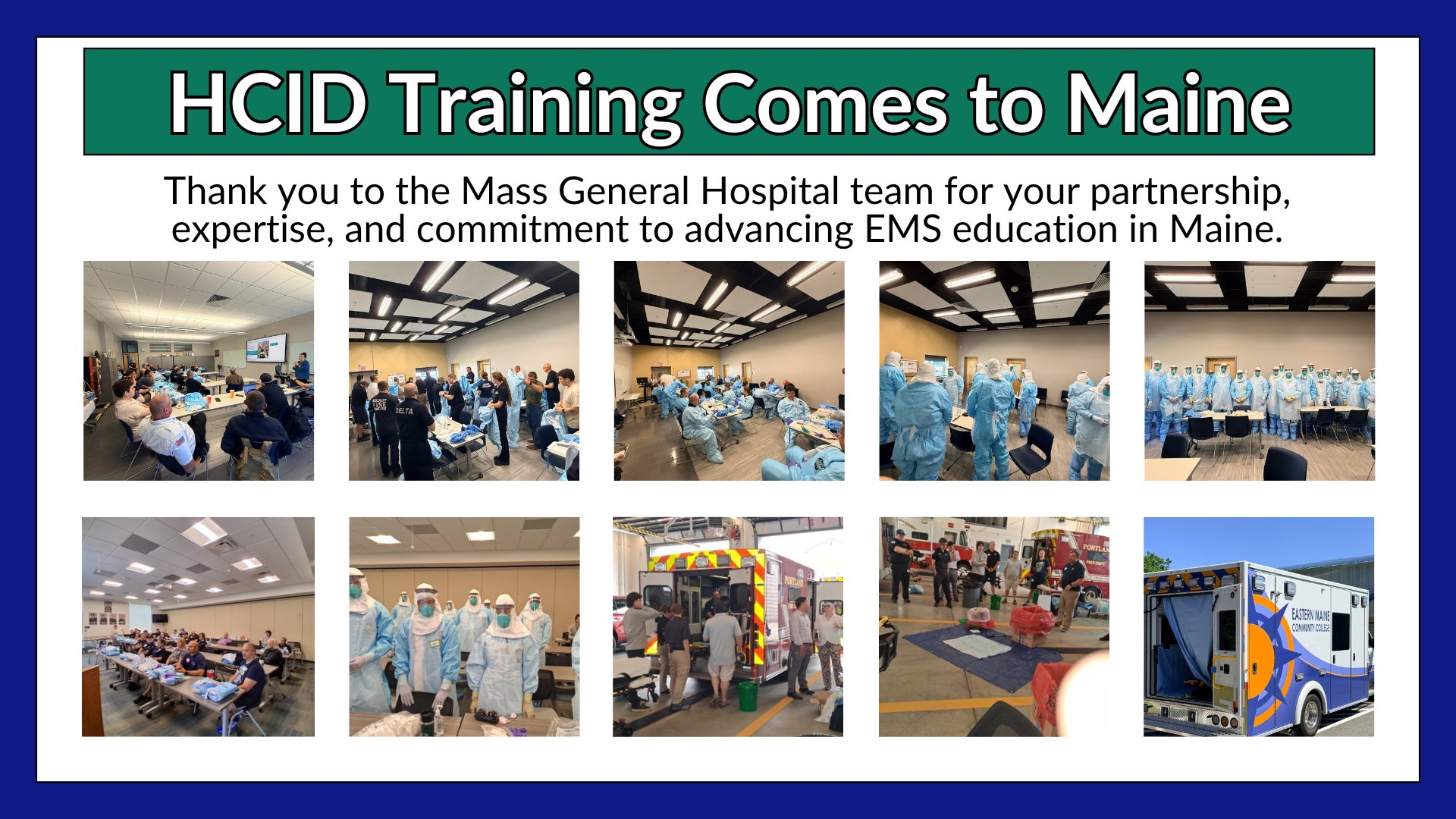
Maine EMS & Maine CDC recently partnered with the Mass General Hospital Center for Disaster Medicine to deliver two High-Consequence Infectious Disease (HCID) Transport Awareness courses for EMS clinicians across the state. The trainings were held at the Public Safety Training Center in Scarborough and the Eastern Maine Community College Public Safety Training Center in Bangor.
Designed to strengthen Maine's preparedness for transporting patients with high-consequence infectious diseases, the course combined a two-hour online pre-course with four hours of in-person instruction and hands-on learning. Participants explored key concepts including infection prevention and control, transport operations, medical waste management, and strategies to identify and mitigate risks associated with HCID patient transport.
A total of 40 EMS clinicians, along with several observers, participated in the two courses. Attendees represented 16 EMS and fire agencies from communities across Maine, creating an excellent opportunity to share experiences, discuss operational challenges, and build relationships that will support future regional responses.
Participating agencies included:
- Augusta Fire Department
- Belfast Fire & Rescue
- Caribou Fire and Ambulance
- Casco Bay Ambulance Service
- Delta Ambulance
- Fort Fairfield Fire Rescue
- Gorham Fire Department
- Lincoln Fire Department
- MaineHealth EMS
- Orono Fire Department
- Portland Fire Department
- Presque Isle Fire Department
- Richmond Fire Department
- Scarborough Fire Department
- Southwest Harbor-Tremont Ambulance
- United Ambulance Service
The training was delivered by instructors from the Mass General Hospital Center for Disaster Medicine, whose expertise and practical approach provided participants with valuable operational knowledge and confidence. Maine EMS extends its sincere appreciation to the Mass General team for their partnership and commitment to strengthening EMS preparedness throughout the state.
Maine EMS also thanks the Public Safety Training Center in Scarborough and Eastern Maine Community College for hosting these courses, as well as every participant and agency that invested their time in this important training. Continued collaboration and education are essential to ensuring Maine's EMS system remains prepared to safely respond to emerging public health threats and protect the communities we serve.