MOOSE Learning Progressions
The MOOSE Computer Science Learning Progression is designed to introduce students to computer science while applying their learning to real-world problems. Our goal is that students see that computer science as accessible and connected to their lives.
Key Themes
- Problem Solving with Computational Thinking
- Computers & People
- Data
- Programming (introduced in Grades 3-5)
- Interdisciplinary, real-world applications
Round 1 modules had 3 major themes
- Problem Solving with Computational Thinking
- Computers & People
- Programming (starting in the 3-5 modules)
Round 2 modules themes shifted to
- Problem Solving with Computational Thinking
- Data
- Computers & People
These modules are interdisciplinary, meaning they embed the computer science themes into other content areas like the arts, humanities, and sciences. Modules in the Computer Science Learning Progression answer the following guiding question: How do I solve real-world problems with computer science.
Computational Thinking Progression
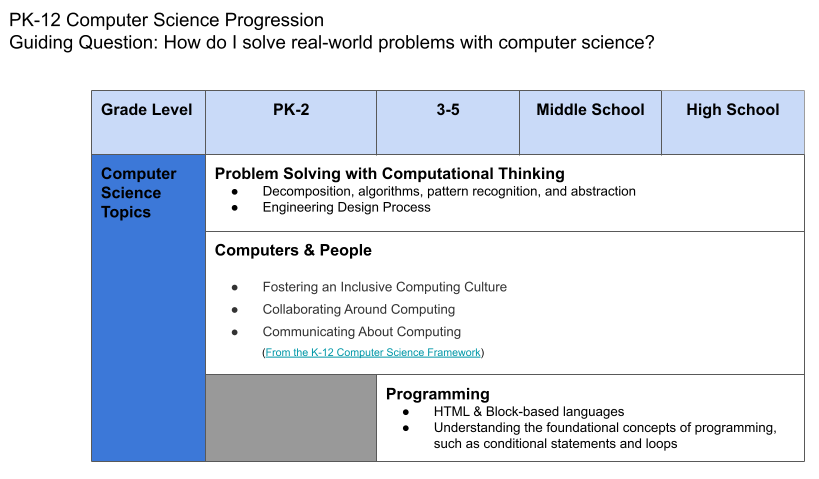
Computer Science Topics by Grade Band
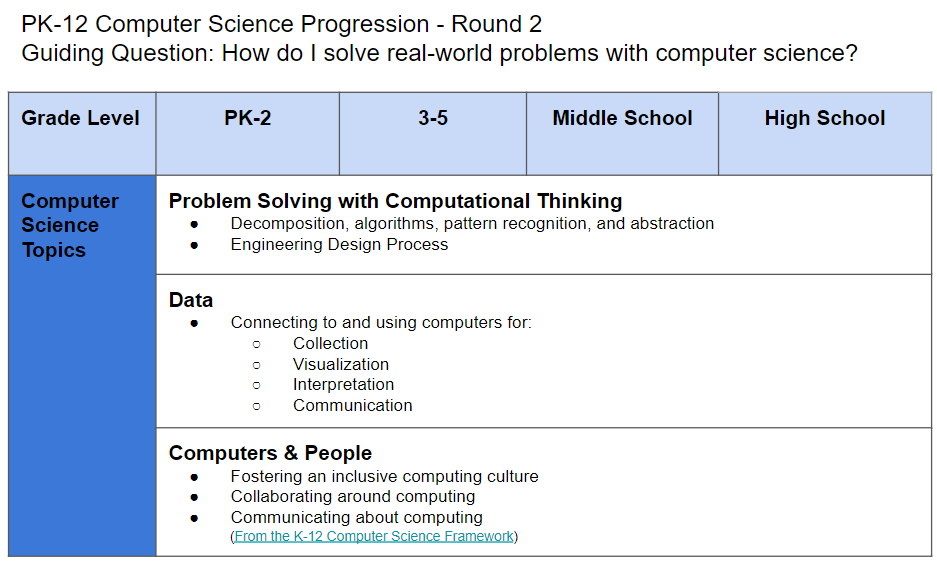
Explore the Modules
Grades PreK-2
PK-2 modules focus on computational thinking and the human aspect of computers at the level of self, family, and classroom.
Grades 3-5
Grades 3-5 modules deepen students' understanding of computer science concepts and begin to apply programming to solve problems at the level of school and community.
Grades 6-8
Grades 6-8 modules continue that work at the level of town and region.
Grades 9-12
Grades 9-12 modules continue the work at the level of state and systems.
The modules in this Learning Progression were made possible by a partnership with the Maine Mathematics and Science Alliance.