Home → Waste Management → Programs → Hazardous Waste/Universal Waste → 2026 Rule Changes
2026 Updates to Maine's Hazardous Waste Management Rules
Maine’s Hazardous Waste Management Rules have been updated, effective July 7, 2026. A brief overview of substantive changes to the Rules, 06-096 C.M.R. chs. 850 through 859, is outlined below. Visit the Hazardous Waste/Universal Waste Program webpage to view and download the full set of Rules.
References to 40 C.F.R. in Maine's Rules
Chs. 850 - 858
Most references to 40 C.F.R. that formerly pointed to Part 264 or Part 265 now point to Part 262, if there is a relevant generator standard. References have also been updated to the 2023 version of 40 C.F.R.
Hazardous Waste Pharmaceuticals
Ch. 859
Ch. 859, § 10(D)
Maine has adopted EPA’s Subpart P for management of hazardous waste pharmaceuticals; see new Chapter 859. Applies to healthcare and veterinarian facilities.
Note: Pharmaceutical aerosols may be managed as non-creditable hazardous waste pharmaceuticals (includes residues in inhalers, aerosol cans and nebulizers); or they may be managed as universal waste under ch. 858.
Generator Category Determination
Ch. 851, § 7
New section: A generator must determine its generator category based on the amount of hazardous waste generated each calendar month; it may change from month to month. Generators must comply with the requirements applicable to their generator category.
Generator Category Terminology
Ch. 851, § 3(E)
ME LQG is now ME Fully-Regulated Generator.
ME SQG is now ME VSQG.
ME SQG+ is now ME VSQG+.
No changes to generation or accumulation rates.
VSQG/VSQG+ Standards
Ch. 851, § 8
Regulations for ME VSQGs and VSQG+s have been moved and are now located in the same chapter as ME fully-regulated generators.
Generic State ID MEX020000000
Ch. 851, § 6(A-B)
The generic ME State ID for ME VSQGs has been discontinued. All ME VSQGs must obtain a unique EPA or State ID. Universal waste-only and/or waste oil-only generators must obtain a unique EPA or State ID if shipping on a hazardous waste manifest or Maine Uniform Bill of Lading.
Re-Notification
Ch. 851, § 6(C)
ME VSQGs and VSQG+s must notify starting in 2026 and must re-notify every 5 years thereafter by Sept 1st (on a rolling basis).
ME fully-regulated generators must re-notify by March 1st of every even year thereafter (i.e., federal SQGs and LQGs).
Episodic Generation
Ch. 851, § 15(I)
Maine now allows notifications for Episodic Events. Federal VSQGs and SQGs may submit an episodic notification in RCRAInfo to conduct one planned or unplanned episodic event in a calendar year, and may petition for a second event of the other type in the same calendar year, without it counting toward overall generator category calculations.
Note: Use EPA Form 8700-12; contacting the Department for a Provisional (‘MEP’) ID is not an episodic notification.
Satellite Accumulation Areas
Ch. 851, § 10(C)
More details on management of hazardous waste containers in satellite accumulation areas were added.
Pre-transport Requirements
Ch. 851, § 10(A), § 10(B)
Marking and labeling requirements for storage and transport of hazardous waste containers have been updated.
VSQG/VSQG+ Consolidation
Ch. 851, § 15(J)
Fully-regulated generators may accumulate on-site, hazardous waste received from ME VSQGs or VSQG+s under control of the same person, if certain requirements are met, including notification of the activity and annual reporting.
Closure and Partial Closure
Ch. 851, § 13
Closure rules for fully-regulated generators have been updated, including the notification timeframes, and that closure can cover the entire site or only portions of a site. Certification of closure must be made by the generator and by an independent qualified professional person.
Universal Waste Categories
Ch. 858, § 4(A, I, K, T)
Ch. 858, § 7(W, CC, DD)
**Ch. 850, § 3(A)(4)(a)(xxvi)
Aerosol Cans* and Electronic Devices** categories have been added, and LED lamps have been added to the Lamp category.
*see also Hazardous Waste Pharmaceuticals note. Ch. 858 § 7(CC) allows can puncturing without a license, if certain conditions are met.
**Ch. 858 definition differs slightly from the Sustainability Program. Ch. 850 has an exclusion for shredded circuit boards being recycled.
Maine Uniform Bill of Lading
(ME UBOL)
Back of 8-part form, Item 11
Unit codes for
- Aerosol Cans (‘AE’),
- Electronic Devices (‘ED’),
- Non-Hazardous waste (‘NH’), and
- Solar Panels (‘SP’) have been added to the form.
These items may be shipped on a ME UBOL.
For more information, contact the Hazardous Waste Management Unit
Central Maine Regional Office:
17 State House Station
28 Tyson Drive
Augusta, Maine 04333-0017
Tel: 207-287-7688
Regional Offices:
Southern Maine (Portland): 207-822-6300
Eastern Maine (Bangor): 207-941-4570
Northern Maine (Presque Isle): 207-764-0477
FAQ
- Will the updated generator standards and recordkeeping requirements in 06-096 C.M.R. chs. 850 and 851 create any substantive changes for Very Small Quantity Generators?
-
The following changes may affect Very Small Quantity Generators:
- The terminology for Maine’s smallest generator categories has changed from ME Small Quantity Generator/Small Quantity Generator Plus (“ME SQG/SQG+”) to ME Very Small Quantity Generator/Very Small Quantity Generator Plus (“ME VSQG/VSQG+”), and the ME VSQG generator standards have been moved from ch. 850 to ch. 851, § 8.
- ME VSQGs may no longer use Maine’s generic State ID (MEX020000000) to ship waste off-site, as it has been discontinued; see ch. 851, § 6(A). Note: A ME VSQG may obtain an EPA ID or State ID, but ME VSQG+ must obtain an EPA ID.
- ME VSQGs must notify beginning in 2026, and re-notify every five years thereafter on a rolling basis, per ch. 851, § 6(C).
- Maine has adopted the federal exclusion for management of airbag waste; see ch. 850, § 3(4)(e).
- Maine has added aerosol cans as a category of universal waste in 06-096 C.M.R. ch. 858.
- Does this provision require every hazardous waste generator, including ME VSQGs, to obtain a site-specific EPA identification number? Will generators still be permitted to use Maine’s generic identification (“ID”) number (MEX020000000) where previously allowed?
-
ME VSQGs, as well as waste oil- or universal waste-only generators who ship using a manifest or Maine Uniform Bill of Lading (“ME UBOL”), will no longer be able to use Maine’s generic ID number when shipping hazardous waste off-site on manifests. They will need to obtain a unique ID number by notifying the Department of Environmental Protection (“the Department”) or by submitting an EPA ID request in RCRAInfo. The Department is envisioning using EPA’s myRCRAid industry application for electronic notification; EPA Form 8700-12 for paper submissions; creating a new form similar to what is currently used for universal waste notifications; or some combination of all of the above. For assistance with the new notification requirements, contact any person in the Hazardous Waste Management Unit for help by calling the main switchboard in Augusta at (207) 287-7688.
- Are generators required to create and retain separate monthly records documenting the quantity of hazardous waste generated and the resulting generator category? If so, what documentation is considered sufficient? For example, would container accumulation dates and existing waste inventory or shipment records satisfy the requirement?
-
All generators are responsible for determining if any of their wastes are hazardous waste and determining their generator category. Neither EPA nor the Department require logging hazardous waste quantities for tracking generator status. A generator could use a generation log system to comply with the generator category determination, but it is not required. Generators could also roll tracking generator status into weekly inspections by adding the desired tracking info into the facility’s inspection form.
- Is a regulated entity allowed to create a RCRAInfo Industry User account using a general company email address, such as ‘environmental@company.com’; and can multiple people use the same account to access RCRAInfo?
-
No. Per EPA’s directive, multiple people are not allowed to use the same account to access RCRAInfo, and the email address associated with an Industry User’s account should be specific to that person. However, a general email address may be used for the primary and/or secondary site contact listed in section 8/8b of EPA Form 8700-12.
- Ch. 851, § 6(C)(1) states that VSQG/VSQG+ generators must notify starting in 2026; do they have to notify by September 1, 2026?
-
They should notify by September 1st or prior to the next shipment of hazardous waste off-site.
- Does a Maine hazardous waste Annual Report satisfy the five-year re-notification requirement? Are re-notifications required in fixed years beginning in 2026, for example, 2026, 2031, 2036 ad infinitum?
-
ME VSQG and VSQG+ generators do not have to submit an annual hazardous waste report, so the notification and re-notification submissions will be separate. The Department interprets the language in ch. 851, § 6(C)(1) to be a rolling date, meaning if a company notifies for the first time in 2027, then the re-notification would be due by September 1, 2032. Those that notify in 2026 would be due for re-notification in 2031.
- If a generator does not submit an Annual Report because the facility made no hazardous waste shipments during the reporting year, do they need to submit a notification by September 1st?
-
The Department is planning to incorporate re-notifications for Fully-Regulated generators into its Annual Report requirement. March 1, 2028, will be the date that all Fully-Regulated generators would be expected to re-notify, and this date ensures Maine will be on the same re-notification schedule as EPA. The generator would be expected to submit a separate re-notification by March 1st if they do not file an Annual Report.
- Are ME VSQG/VSQG+ facilities required to label containers with an accumulation start date as well as a full date, since they have 180 days from the full date to ship off-site?
-
Yes. Ch. 851 § 8(D)(2) refers to ch. 851 § 10(B)(3), which states that “[A generator may accumulate hazardous waste on the site of its generation…without a license, provided that:…]The date upon which each period of accumulation begins is clearly marked and visible for inspection on each container…”.
- Can a partially filled container in a central accumulation area remain in storage indefinitely, provided the total hazardous waste accumulation quantity does not exceed ME VSQG/VSQG+ limits?
Does the satellite accumulation area (“SAA”) exemption found at ch. 851, § 10(C) apply to ME VSQG/VSQG+ facilities? -
ME VSQG and VSQG+ facilities can take as much time as needed to fill a container with hazardous waste, so the SAA exemption found at Chapter 851, § 10(C) is not necessary. The Department recommends that the generator also adhere to any safe storage considerations outlined in a chemical’s Safety Data Sheet (“SDS”).
- What are the updated requirements for labeling hazardous waste containers and tanks?
-
Ch. 851, § 10(B)(3): The date upon which each period of accumulation begins is clearly marked and visible for inspection on each container or tank and while being accumulated on-site each container or tank is labeled or marked clearly with the words, "Hazardous Waste". Each container or tank must have an indication of the hazards of the contents (examples include, but are not limited to, the applicable hazardous waste characteristic(s) (i.e., ignitable, corrosive, reactive, toxic); hazard communication consistent with the Department of Transportation requirements at 49 C.F.R. part 172 subpart E (labeling) or subpart F (placarding); a hazard statement or pictogram consistent with the Occupational Safety and Health Administration Hazard Communication Standard at 29 C.F.R. § 1910.1200; or a chemical hazard label consistent with the National Fire Protection Association code 704). A container or tank should be labeled as soon as hazardous waste is placed in it. If reusing a container, all old labels should be removed first.
- Is this regulation interpreted to mean one time per week Sunday – Saturday, thereby a generator could do the inspection on any day of a given week; or must the inspection occur every seven days?
-
The weekly inspection requirement means one time per week Sunday – Saturday, so if an inspection is conducted and recorded at least once in a calendar week, the generator is in compliance.
- If a generator relocates a central accumulation area or other hazardous waste accumulation unit within an operating facility, does discontinuing use of the original area trigger the closure requirements in ch. 851, § 13(E)?
-
Yes, a Fully-Regulated generator would need to complete EPA Form 8700-12 if a central accumulation area is moved or removed.
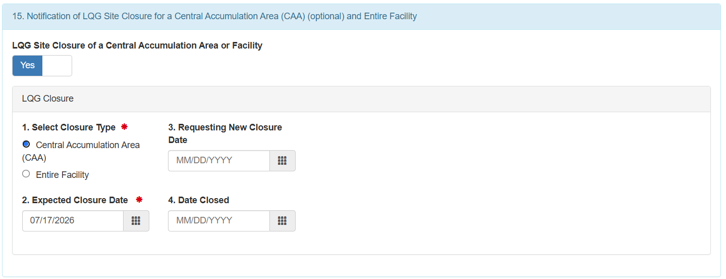
Place an “X” in the “Y” box, if you are notifying of a stage of closure of a central accumulation area or generator site, then complete the appropriate boxes: 15.A – D. Otherwise, place an “X” in the “N” box.
- Indicate if you are closing a central accumulation area or are closing the entire facility.
- Provide the date (mm/dd/yyyy) that you expect to close the CAA or the entire facility.
- If you cannot complete the closure of your facility (or central accumulation area) within 90 days of starting the closure process, indicate the new closure date (mm/dd/yyyy)
- Provide the date (mm/dd/yyyy) that the facility or CAA closed.
- Who can utilize the alternative standards for episodic generation?
-
ME VSQG and VSQG+ generators. The Department encourages federal Small Quantity Generators (“SQGs”) to file notifications of episodic events if they want to take advantage of federal biennial reporting requirement exemptions.
- What is a planned versus unplanned episodic event?
-
See 40 C.F.R. § 262.231 for definitions.
- When and where should a generator submit a notification for an episodic generation event?
-
A notification for a planned episodic event must be submitted no later than 30 calendar days prior to initiating the event using EPA Form 8700-12. To notify of an unplanned episodic event, the generator must notify the Department within 72 hours of the unplanned event via phone, email, or fax and subsequently submit EPA Form 8700-12. A notification may be submitted electronically in RCRAInfo via the myRCRAid module, or may be submitted on a paper form to the Department via mail or email. Mail forms to the attention of the Hazardous Waste Management Unit at:
17 State House Station
28 Tyson Drive
Augusta, ME 04333-0017 - When a generator notifies of an episodic event using EPA Form 8700-12, do they change their generator category in section 10 based on the amount of hazardous waste managed under the alternative standards for episodic generation?
-
No. The federal and state generator categories listed in section 10 remain the same. A ME VSQG/VSQG+ generator will indicate ‘Yes’ in section 13.
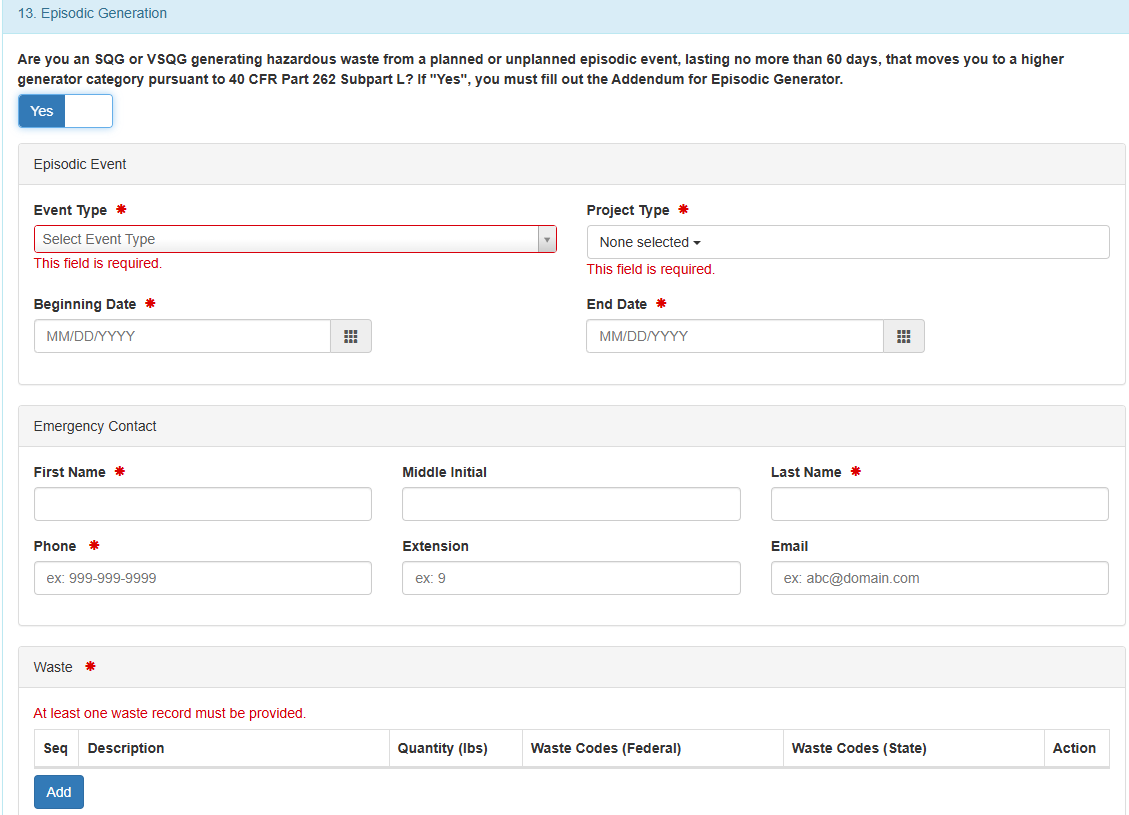
Place an “X” in the “Y” box, if you are a VSQG or SQG notifying that you are taking advantage of the episodic generator event provision in 40 CFR 262.232. You must also complete the Addendum to the Site Identification Form for Episodic Generation. Information to be completed includes:
- the type of episodic event (i.e., planned or unplanned),
- the name and telephone number of an emergency contact at the site,
- the beginning or start date of the episodic event, and expected completion date (no later than 60 days from beginning date),
- the reason for the episodic event (event description),
- identification of the applicable Federal waste codes (and State waste codes, if applicable), and
- the estimated total quantity of hazardous wastes that will be generated as a result of the episodic event.
- How much time does a generator have to complete an episodic event?
-
The generator has 60 days from the start date to manifest and send its hazardous waste generated from the episodic event to a designated facility. If the hazardous waste is not off-site within 60 days, then it must be counted toward the generator's monthly generation rate. The start date for a planned episodic event is the date that the applicable hazardous waste was deemed a waste. An unplanned episodic event begins on the first day the hazardous waste is generated, regardless of whether the generator has completed analysis confirming that the waste is hazardous.
- What are the storage and recordkeeping requirements for episodic events?
-
See 40 C.F.R. § 262.232(a)(4,5,7). The generator is prohibited from accumulating hazardous waste generated from an episodic event on drip pads and in containment buildings; must label/mark containers and tanks with the words “Episodic Hazardous Waste”, the hazards, and the episodic event start date (tank start date may be recorded via an inventory log, monitoring 2026 Hazardous Waste Management Rules FAQs Page 6 of 10 equipment or other records); and must maintain the records listed in 40 C.F.R. § 262.232(a)(7) for three years from the end date of the episodic event.
- Do all releases of hazardous matter need to be reported to the Department?
-
Yes. 06-096 C.M.R. ch. 800 Identification of Hazardous Matter and ch. 801 Discharge of Hazardous Matter: Removal and Written Reporting Procedures are the rules governing hazardous matter. The statutes for Hazardous Matter Control are in 38 M.R.S. Chapter 13, Subchapter 3. All releases of hazardous matter must be reported immediately to the Department of Public Safety (1-800-452-4664) unless the facility has submitted a Spill Prevention, Control and Countermeasures (“SPCC”) Plan for Hazardous Matter to the Department. If an SPCC Plan has been filed that includes the hazardous matter that was released, then only those spills that exceed the chemical’s reportable quantity must be reported to the Department.
- Is a hazardous waste contingency plan required for all Maine Fully-Regulated generators, or only if the generator is a federal LQG?
-
Maine’s Fully-Regulated generator category encompasses both the federal LQG and SQG categories. All Fully-Regulated generators need to have a contingency plan.
- Is annual training required for ME VSQG and ME VSQG+ facilities?
-
No, only Fully-Regulated generators must complete training on an annual basis.
- To whom or what program within the Department should generators submit these agreements?
-
The Director of Response Services is the person who can sign a mutual aid agreement on behalf of the State Emergency Response Team.
- Does the annual review require resubmission to the Department when the agreement has not changed?
-
A copy of the contingency plan required under 40 C.F.R. 262 Subpart M should be submitted to the emergency responders; and whenever the plan is amended, the emergency responders should get the updated plans. The mutual aid agreements should be updated annually and in writing. Note that 40 C.F.R. § 262.262(b) requires the generator to provide a quick reference guide for the contingency plan to the local emergency responders as well.
- What documentation is sufficient to demonstrate that an unchanged agreement was reviewed annually?
-
The Department recommends that the requests for mutual aid agreements be sent via certified mail or some other method that tracks receipt to verify that the request has been made by the generator. As long as the generator can document that they have made the request(s), the requirement is considered met, even if the mutual aid agreements are not returned to the generator.
- Has Maine opted into EPA’s e-Manifest Third Rule?
-
No, Maine did not opt into EPA’s e-Manifest Third Rule in this round of rulemaking; the Department intends to address the e-Manifest Third Rule changes in a future rulemaking. In the meantime, EPA can enforce its rule in the State of Maine. The Department may contact the generators in question and ask them to comply with the federal rule. Furthermore:
- Until Maine adopts the Third Rule, all Maine generators must notify the Department if they have not received the Designated Facility to Generator manifest copy within 35 days of shipment, and submit an Exception Report to the Department if the manifest hasn’t been received within 45 days.
- As of December 1, 2025, EPA requires generators to submit all Exception Reports electronically through e-Manifest unless the generator is categorized as a federal VSQG (which includes Maine’s VSQG and VSQG+ categories) or a PCB generator.
- As of January 22, 2025, EPA’s timeframe requirements for Exception Reports have changed:
- If a signed copy of the manifest has not been submitted within 45 days of the date the waste was accepted by the initial transporter, LQGs must inquire of the transporter or designated facility about the status of its waste.
- If a signed copy of the manifest has not been submitted within 45/60 days of the date the waste was accepted by the initial transporter, federal SQGs and LQGs (Maine’s Fully-Regulated category) must submit an Exception Report.
- Fully-Regulated generators must have at least one company-affiliated Site Manager registered to manage their ID in RCRAInfo. Additional Site Managers may be third-party consultants, if proof of authorization is provided to the Department (not required if an existing Site Manager approves third-party permissions directly).
- Do generators need to submit copies of shipping documents to the Department?
-
Domestic shipments on a hazardous waste manifest – no, they are uploaded into e-Manifest by the receiving facility.
International shipments on a hazardous waste manifest – no, e-Manifest now accepts import/export manifests. For more information go to Frequent Questions about Hazardous Waste Imports and Exports, Information for Importers and Receiving Facilities of Resource Conservation and Recovery Act Hazardous Waste, and Information for Exporters of Resource Conservation and Recovery Act (RCRA) Hazardous Waste .
ME Uniform Bill of Lading (“ME UBOL”) – yes, generators are required to mail or email copy 7 (Generator State – Mailed by Generator) to the Department, as well as copy 6 (Destination State – Mailed by Generator) if applicable, within seven days of initiating shipment. The receiving facility is required to mail or email copy 2 (Generator State – Mailed by Recycling Facility), as well as copy 1 (Destination State – Mailed by Recycling Facility) if applicable, within seven days of receipt. See ch. 857, § 6(B) and § 12, and the back of the ME UBOL form, for more information.
Non-hazardous waste manifest and straight Bill of Lading – these document types are not valid for shipping hazardous waste or universal waste generated in Maine, with certain allowances for shipping intact universal waste batteries on a straight Bill of Lading (“BOL”). Contact the Hazardous Waste Management Unit for more information about Alternate Standards for tracking and reporting universal waste under ch. 858, § 11.
- Should the on-site universal waste item count include electronic devices and aerosol cans? The parenthetical examples in the rule identify lamps, thermostats, batteries, and individual architectural paint containers but do not identify electronic devices or aerosol cans.
If these wastes must be counted, what constitutes one “item”? For example, each individual electronic device or aerosol can, rather than each container holding those wastes? -
Ch. 858, § 4(S): Small Universal Waste Generator. Small Universal Waste Generator means a person or entity that generates in any calendar month or accumulates on-site at any one time no more than:
- (1) 200 universal waste items, including batteries as described in Section 12 of this Chapter, or
- (2) 4,000 motor vehicle mercury switches, or
- (3) 40 tons of cathode ray tubes.
Yes, individual electronic devices and aerosol cans should be included in the item count when determining whether a site is operating as a Small Universal Waste Generator or a Large Universal Waste Generator. Only cathode ray tubes and motor vehicle mercury switches are allowed different collection limits before being considered a Large Universal Waste Generator. The language in parentheses in ch. 858, § 7(J) was meant as examples of items that should be counted. To calculate the “number of universal waste items” as stated in § 7(J), include items under the definition of universal wastes in ch. 858, § 4(T), and include batteries per the definitions of Small and Large Universal Waste Generators in § 4.
- If a generator ships to a facility for the management of electronic devices, where all items would still be considered "product" rather than waste until the receiving facility reviewed the condition of each item for re-use versus recycling, would an inventory need to be maintained?
-
Yes, the generator should include the e-waste items in their inventory. If they ship off items that are later deemed usable, they can make a note to that effect in their inventory log (e.g., e-waste item count=50 on inventory, with a note that x items were deemed usable by receiving facility, so they are not universal waste).
- How should a Central Accumulation Facility count their inventory for weekly inspections (number of containers versus number of individual items)?
-
The inventory should include the number of individual items received. Central Accumulation Facilities (“CAFs”), which includes transfer stations and sign service companies, need to meet the requirements in ch. 858, § 8. Weekly inspection records should include the name of the inspector, date of inspection, number of containers, condition of original waste containers and collection containers, and descriptions of actions taken to address any problem discovered during the inspection. In addition, CAFs need to maintain an inventory system on-site that identifies the date; and the manifest or Uniform Bill of Lading number, or log system information i.e., name of generator, log date, type and number of universal waste items for each universal waste container or group of containers that is received at the facility, and the date and manifest or Uniform Bill of Lading number (if applicable) for each waste container or group of containers that is shipped from the facility. CAFs should be able to determine the number of individual items on-site from the shipping documents provided to them when receiving universal waste.
- How should generators determine whether a component contains a “circuit board” and qualifies as an electronic device? For example, would USB cables, adapters, and similar peripheral components containing small circuit boards be regulated as universal waste electronic devices?
-
Ch. 858, § 4(I): Electronic Devices means a device or component thereof that contains one or more circuit boards and is used primarily for communication, data transfer or storage, or entertainment purposes, including but not limited to, desk top and lap top computers, computer peripherals, monitors, copying machines, scanners, printers, radios, televisions, camcorders, video cassette recorders (“VCRs”), compact disc players, digital video disc players, MP3 players, telephones, including cellular and portable telephones, and stereos.
Computer peripherals are external devices that are connected to a computer to expand its capabilities. A mouse, keyboard, or external hard drive are common examples of what is meant by computer peripherals. The use of the term in the definition is meant to broaden the list of items that can be managed as an electronic device as technology changes and not be limited to only a specific list of items. Cables are generally not included in the definition of electronic devices, while power adaptors with circuit boards would be included, but the Department encourages their recycling either way. Universal waste handlers are encouraged to contact the Department for clarification on what would meet the definition of an electronic device.
- Gaylord boxes are open top by design; can electronic devices be accumulated in open gaylords?
-
The rules require that containers of universal waste be kept closed unless adding or removing waste. That does not mean that the collection container must be sealed before it is full. Closed can mean placing a piece of cardboard or plywood over the top, or resting the gaylord cover on top when it is not being filled. If the box has flaps, they can be folded or held closed with something like binder clips or Velcro tabs.
- May non-empty waste aerosol cans containing characteristic or listed hazardous waste be managed as universal waste per 06-096 C.M.R. ch. 858, § 4(T)?
-
Yes, aerosol cans may contain characteristic and/or listed waste when being managed as universal waste. Specific requirements for managing and puncturing aerosol cans are found at ch. 858, § 7(CC)(5). The handler that punctures and drains the aerosol can(s) is responsible for the hazardous waste determination of the contents of the aerosol can(s).
- What is the most recent version of ch. 860?
-
06-096 C.M.R. ch. 860 – Waste Oil Management Rules, effective November 8, 2006.
- How should a waste oil generator label a container or tank when the waste oil does not meet the definition of hazardous waste?
-
Because there are no management standards for used/waste oil generators in the current version of ch. 860, used/waste oil generators should refer to the federal regulations in 40 C.F.R. Part 279 – Standards for the Management of Used Oil. Labeling waste oil containers or tanks with “Used Oil” or “Waste Oil” is acceptable. EPA specifies “Used Oil”.
Generator standards and recordkeeping for VSQGs
EPA identification numbers – 06-096 C.M.R. ch. 851, § 6(A)
Monthly generator category determination – 06-096 C.M.R. ch. 851, § 7
Industry User RCRAInfo accounts
Generator notification and re-notification – 06-096 C.M.R. ch. 851, § 6(C)
For ME VSQGs and ME VSQG+
ME VSQG/VSQG+ hazardous waste accumulation – 06-096 C.M.R. ch. 851, § 8(D)
Labeling containers and tanks – 06-096 C.M.R. ch. 851 § 10(B)(3)
Weekly inspections of hazardous waste containers, including containers at satellite accumulation areas – 06-096 C.M.R. ch. 851, § 15 D(1)
Closure of accumulation units – 06-096 C.M.R. ch. 851, § 13(E)
Episodic generation – 06-096 C.M.R. ch. 851, § 15(I)
Reporting releases of hazardous matter – 06-096 C.M.R. chs. 800 - 801
Hazardous waste contingency plan – 06-096 C.M.R. ch. 851, § 10(B)(5)
Annual training requirement – 06-096 C.M.R. ch. 851, § 10(B)(5)
Written aid agreements – 06-096 C.M.R. ch. 851, § 15(C)(7)(c)(ii)
The rule requires aid agreements under 40 C.F.R. § 262.256 to be in writing, on file with each party to the agreement and with the Department, readily accessible to facility personnel, and reviewed and updated annually.