Home → Land Resources → Permits & Standards → NRPA → Vernal Pools → Vernal Pools: A Significant Wildlife Habitat (fact sheet)
Fact Sheet:
Significant Vernal Pool Habitat Rule Changes
Effective May 17, 2026, Maine Department of Environmental Protection (DEP) rules governing activities in Significant Vernal Pool (SVP) Habitat have been updated pursuant to Public Law 2025, chapter 338 to enhance protections for SVPs. Here’s what has changed:
-
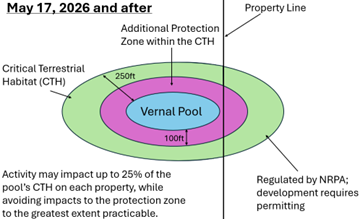
100-foot Significant Vernal Pool protection zone - In addition to the 250-foot radius of regulated habitat surrounding SVPs, the updated rules include a 100-foot “SVP protection zone” that restricts development activities allowed through DEP permitting.
- Unless otherwise noted, development activities within the 100-foot protection zone are not eligible for Permit-By-Rule (PBR) approval.
- Applicants will be required to demonstrate that disturbance within the protection zone has been avoided to the greatest extent practicable.
- At the discretion of the Department, a PBR may be issued within the 100-foot protection zone for the following activities:
- A six-foot-wide footpath that is not paved and not made of gravel.
- Activities on a single residential lot that cannot be located elsewhere on the lot.
- Eligible activities must still maintain a 25-foot buffer around the pool depression.
- In addition to the 250-foot radius of regulated habitat surrounding SVPs, the updated rules include a 100-foot “SVP protection zone” that restricts development activities allowed through DEP permitting.
- Property boundaries
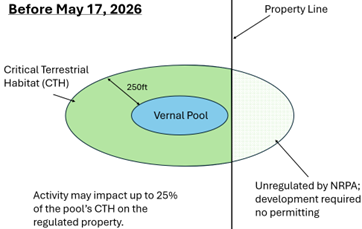
- SVP Habitat is now afforded the same protection regardless of property boundaries (Figures 1 and 2).
- The 250-foot radius surrounding a mapped SVP is the regulated critical terrestrial habitat, subject to permitting requirements under Chapter 335 and 305 of the Department’s rules, regardless of whether the SVP is located on the applicant’s property.
- To the greatest extent practicable, applicants must maintain 75% of the critical terrestrial habitat present on their property.
- Permitting requirements will only apply if the vernal pool on an abutter’s property has been deemed significant. Maine Department of Inland Fisheries and Wildlife significant vernal pool map.
Do you think that you might have a vernal pool near you? Here are a few ways to identify them:
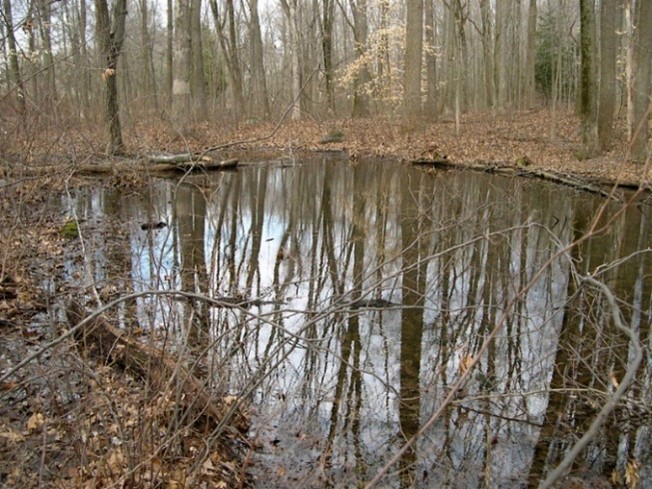
- A low-lying depression or small pond that looks naturally made, some are surprisingly large!
- The pool has no inlets or outlets. Isolation from predators is vital for the amphibians and invertebrates that use vernal pools.
- The pool must dry out almost completely for parts of the year.
If a pool near you has these characteristics, it may be a vernal pool! Contact the DEP Field Services team for a springtime evaluation to confirm.
Citation
06-096 C.M.R. chapters 335 and 305 (last amended May 17, 2026)
Public Law 2025, chapter 338