The Maine Department of Energy Resources (DOER) is required by law to update the Maine Energy Plan every two years. The Plan is informed by in-depth technical analyses and robust stakeholder input, and offers objectives, strategies, and actions to ensure affordable, reliable, and increasingly clean energy for Maine people and businesses. DOER published the most recent Energy Plan in January 2025 and will develop the next plan over the course of 2026.
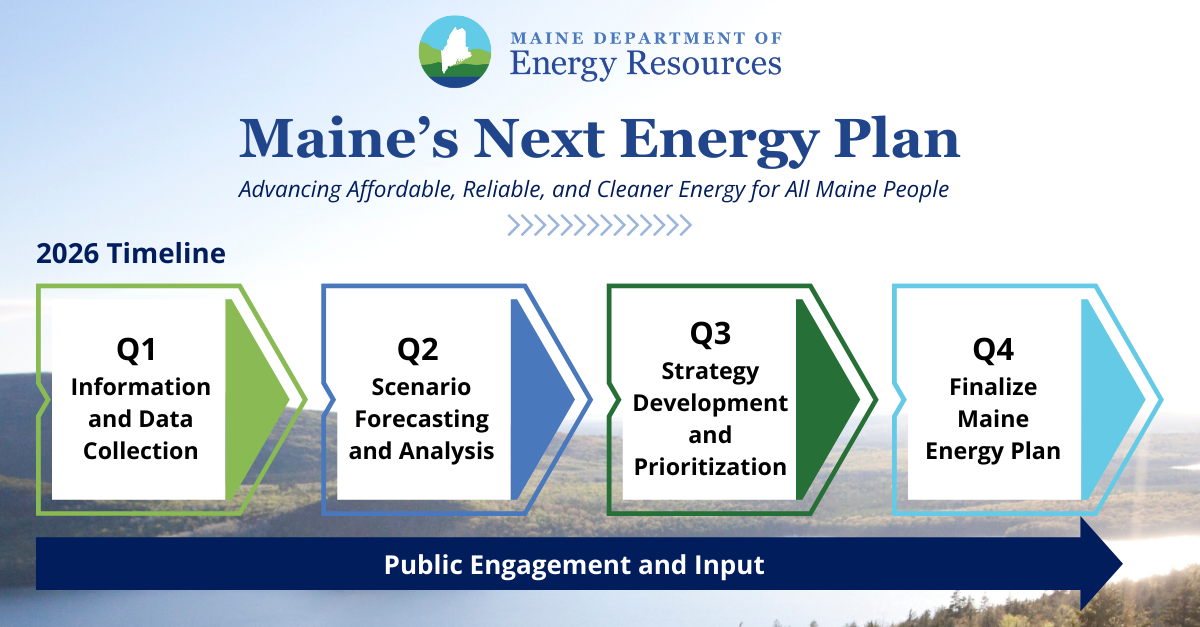
About Maine’s 2027 Energy Plan
The 2027 Maine Energy Plan will include forecasts of Maine’s expected energy needs across all sources of demand – from heating and cooling buildings, to transporting people and goods, to powering our industries and homes. The Plan will be informed by a range of recent and ongoing analyses completed by DOER and other relevant entities such as ISO New England, the Maine Public Utilities Commission and the Efficiency Maine Trust. These will include new studies directed by the Legislature examining Maine’s transmission and generation needs. In addition, the Energy Plan will be informed by robust technical analysis, developed by independent experts, to forecast energy demand and identify supply options based on the latest information about energy use, technologies, economic changes, weather patterns, and other relevant trends.
Maine's 2027 Energy Plan will address several priorities to ensure energy is:
- Affordable – Maine's overreliance on fossil fuels is burdening residents and businesses with volatile energy costs. The Maine Energy Plan will document the energy spending that occurs today, exploring how that spending impacts Maine people, and identifying strategies to lower total energy costs over time.
- Reliable – In order to be useful, energy must be available where and when it is needed most – such as through a resilient electric grid that can withstand and recover quickly from major storms, and through adequate heating fuel supply. The Maine Energy Plan will identify and compare reliability trends and explore ways to increase reliability in the face of new challenges.
- Secure – Maine relies on energy that travels into and throughout the state through an interconnected system of physical infrastructure, transportation, and communications. This system must be appropriately maintained and secure.
- Clean – Maine is required by law to increase the portion of electricity sold in the state that comes from renewable and clean sources until that share reaches 100 percent by 2040. These laws help to reduce volatility of electricity costs, lower Maine’s reliance on expensive imported fuels, and drive job creation and investment across the state.
How to Participate
The Maine Energy Plan is a tool for policymakers, communities, businesses, and interested citizens across the state to understand the state’s energy situations and the opportunities available to build a stronger energy future for the state. Throughout the development of the next Energy Plan, DOER will seek public input through:
- Public meetings and webinars: DOER will host public meetings to share draft results and gather feedback to inform the final Plan. Upcoming meetings on the Maine Energy Plan will be available below and on the DOER public meetings page. Previous meetings will be listed in the meeting archive.
- Stakeholder survey: The Department is seeking public input through a short online survey. Interested individuals or organizations are invited to complete the survey to share input.
- Meet with DOER: Interested parties, organizations, and communities in Maine are encouraged to request DOER to present about the Maine Energy Plan process, provide input to shape the next plan, and ask questions. Please complete this short form on behalf of your group or organization and someone from the Department will be in touch.
- Receive email updates: To receive email updates on the Maine Energy Plan, including information about upcoming meetings, opt-in to the DOER general newsletter here.
Public Meetings
- Maine Energy Plan Kickoff Meeting: March 27, 2026 via Zoom
-
This meeting included a discussion of Maine's 2025 Energy Plan and the planning process to develop the next plan over the course of 2026. The meeting also covered a new Request for Information that DOER released to help inform the next energy plan, initial priorities including an emphasis on affordability, and broad plans for stakeholder engagement throughout the year.
- Maine Energy Plan Public Webinar: August 3, 2026 via Zoom
-
DOER hosted a public webinar to share updated technical analysis of future energy needs in Maine. This webinar provided an overview of the methodology, presented initial draft results, and offered stakeholders an opportunity to provide input.
- Maine Energy Plan Public Workshop: August 19, 2026 in Portland
-
DOER is hosting community workshops across the state to engage with Maine people, businesses, and communities on the state’s energy priorities, challenges, and opportunities. Members of the public are encouraged to attend, share their perspectives, and participate in discussions that will help inform the goals and strategies for ensuring affordable, reliable, and increasingly clean energy in the 2027 Maine Energy Plan.
Date and time: August 19, 2026 from 5:30pm-7:30pm
Location: Glickman Family Library, University Events Room, 314 Forest Ave, Portland, ME
- Maine Energy Plan Public Workshop: August 24, 2026 in Presque Isle
-
DOER is hosting community workshops across the state to engage with Maine people, businesses, and communities on the state’s energy priorities, challenges, and opportunities. Members of the public are encouraged to attend, share their perspectives, and participate in discussions that will help inform the goals and strategies for ensuring affordable, reliable, and increasingly clean energy in the 2027 Maine Energy Plan.
Date and time: | -
Location: Mark and Emily Turner Memorial Library, 39 2nd Street, Presque Isle, ME, 04769
- Maine Energy Plan Public Workshop: August 25, 2026 in Bangor
-
DOER is hosting community workshops across the state to engage with Maine people, businesses, and communities on the state’s energy priorities, challenges, and opportunities. Members of the public are encouraged to attend, share their perspectives, and participate in discussions that will help inform the goals and strategies for ensuring affordable, reliable, and increasingly clean energy in the 2027 Maine Energy Plan.
Date and time: | -
Location: Bangor Public Library, 145 Harlow Street, Bangor, ME, 04401
- Maine Energy Plan Public Workshop: September 10, 2026 via Zoom
-
DOER is hosting community workshops across the state to engage with Maine people, businesses, and communities on the state’s energy priorities, challenges, and opportunities. Members of the public are encouraged to attend, share their perspectives, and participate in discussions that will help inform the goals and strategies for ensuring affordable, reliable, and increasingly clean energy in the 2027 Maine Energy Plan.
Date and time: | 12:00 - 1:30pm
Location: Zoom
Public Comments
On March 25, 2026, the Maine Department of Energy Resources (DOER) issued a Request for Information (RFI) to gather public input for the 2027 Maine Energy Plan. The RFI, which closed on April 27, 2026, sought feedback on changes in Maine’s energy landscape since the 2025 Energy Plan, opportunities to update existing strategies and objectives, and priorities for the next plan. Comments in response to the RFI can be found here (PDF user-submitted). Disclaimer: These files were submitted to DOER by external parties and may not conform to ADA requirements.