The Maine Community Energy Redevelopment Program (MECERP), led by the Maine Department of Energy Resources (DOER) and the Maine Department of Economic and Community Development (DECD) is designed to foster economic development across Maine by providing high-quality technical assistance to projects that unlock community energy assets for economic development.
On October 22, 2024, the Mills Administration announced six communities in Maine will receive technical assistance through MECERP to support locally-determined revitalization projects at current and former industrial sites to create good-paying jobs, drive local economic development, and meet state climate and clean energy goals. The Town of Hartland was the latest to join the program in August 2025. 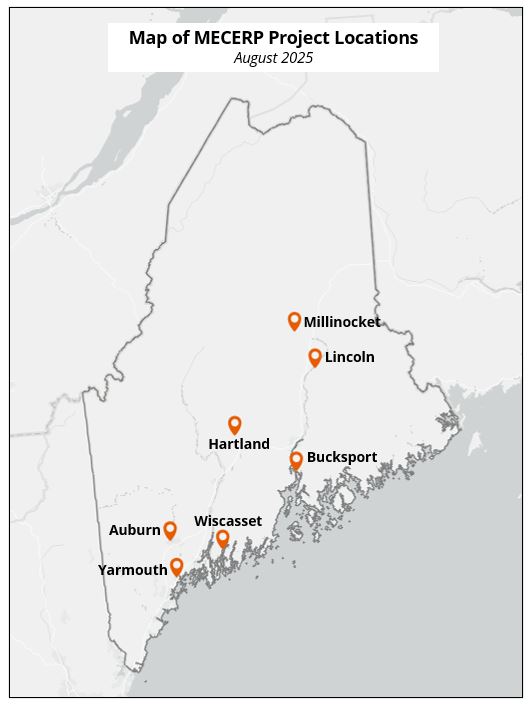
Completed Projects:
-
The City of Auburn worked to catalyze business attraction and industrial growth by creating a cohesive development vision for the land assets in or near the Forest Bioproducts Advanced Manufacturing Tech Hub Overlay. The Tech Overlay was created by the city to align commercial and industrial development with Maine’s state-level Forest Bioproducts Advanced Manufacturing Tech Hub designation by the Biden-Harris Administration.
-
The Town of Bucksport conducted economic development planning (PDF) for underutilized industrial land alongside the Penobscot River near downtown Bucksport. The project focused on areas surrounding the existing thermal power station and transition to clean energy technologies, in partnership with power station owner JERA Americas.
-
The Town of Hartland is advancing remediation and exploring market-feasible uses for the Irving Tannery site that align with the state's target industries. With significant water processing capacity and underutilized electric grid infrastructure, the site offers unique redevelopment potential.
-
The Town of Lincoln developed a business plan to attract additional industrial anchor tenants to the growing Lincoln Technology Park, a 387-acre site formerly known as the Lincoln Paper and Tissue mill. The U.S. Department of Energy awarded Maine a $147 million grant to deploy an 85 MW long duration energy storage system at one site within the park.
-
One North worked to redevelop a 1,400-acre site, the third largest industrial site in Maine, formerly occupied by the Great Northern Paper Company, in Millinocket. The site’s unique energy generation capacity positions it to offer affordable power to industrial users and catalyze new economic activity in the Katahdin region.
-
The Town of Wiscasset conducted economic development planning for two large waterfront sites: the 33-acre Birch Point Peninsula, best known for the decommissioned Mason Station site, and the 297-acre parcel along Old Ferry Road across the road from the decommissioned Maine Yankee Nuclear Plant.
-
The Town of Yarmouth assessed the feasibility and potential impact of alternative future uses for Wyman Station, an aging oil-fired power plant on Cousins Island that currently runs a few days a year during periods of high demand.
Successful projects supported through MECERP bring together partners in the community to collaborate on implementation, help realize Maine’s economic development goals, have a high likelihood of qualifying for state and federal funding, and leverage underutilized or legacy electricity infrastructure.
MECERP Background
Funded through the Maine Jobs and Recovery Plan and led by DOER and DECD, this program is intended to create family-sustaining jobs while reducing carbon emissions, in line with State economic development and climate goals, including:
- The Maine Jobs and Recovery Plan;
- The Maine Won’t Wait Climate Action Plan; and
- The Maine Economic Development Strategy
The objective of this program is to support each participating community to develop a detailed action plan for projects consistent with the state’s climate and clean energy goals and be well-prepared to implement these projects. These projects are required to take place in areas where there is available electric grid capacity or underutilized grid infrastructure.
Project Goals
This program is supporting proposals* for new development or infrastructure deployment where underutilized electricity infrastructure exists (i.e. available electrical capacity on transmission or distribution lines) but will not fund project construction or development.
The following are examples of potential projects which may be considered:
- Redevelopment or adaptive reuse of unused or vacant industrial sites, including brownfield sites;
- Development projects across multiple sites that are close to each other or along a commercial corridor; and
- Already in-progress, but stalled, economic development projects with a nexus to underutilized electricity infrastructure.
Proposed projects must demonstrate the potential to advance Maine’s economic development, clean energy and climate goals, including but not limited to:
- Protecting and creating family-sustaining jobs in Maine’s growing and heritage industries;
- Bolstering small and medium-sized businesses;
- Creating “Hubs of Excellence” or clusters with ideal conditions for economic growth;
- Attracting and retaining talent; and
- Supporting Maine’s growing and heritage industries related to sustainable food sourcing, energy-efficient manufacturing and transportation, and clean energy.
* All projects selected through this program must comply with required state and federal permitting processes. The State’s role in this program is to provide technical assistance to assist communities to develop potential projects and identify potential funding sources.
Technical Assistance
The Project Team will identify promising ideas and provide economic development technical assistance to the selected communities, including but not limited to:
- Project concept development and community visioning;
- Site planning, financial analysis, community engagement, and partnership building;
- Support in identifying and applying for state and federal funding;
- Development of project governance team/strategy, and
- Development of action plans to increase competitiveness for grant opportunities.