DACF Home → Bureaus & Programs → Maine Natural Areas Program → Communities, Plants, and Animals → Natural Community Fact Sheets → Rose Maritime Shrubland
Printer Friendly Fact Sheet - 1 MB pdf (Get a free copy of Adobe Acrobat Reader)
Rose Maritime Shrubland
Scientific Name: Rose - Bayberry Maritime Shrubland; State Rank: S4
- Community Description
- Soil and Site Characteristics
- Diagnostics
- Similar Types
- Conservation, Wildlife and Management Considerations
- Distribution
- Characteristic Plants
- Associated Rare Plants
- Examples on Conservation Lands You Can Visit
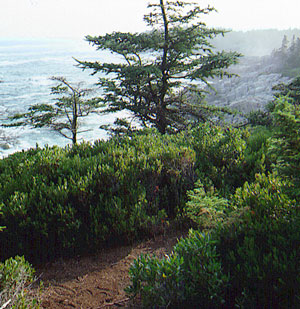
Community Description: Medium height shrubs (1-2 m) usually cover 30-60% but may form dense thickets. Bayberry and roses are characteristic; raspberry and poison ivy are frequent associates. On some islands, shrublands are dominated by raspberry or bush-honeysuckle, with little or no bayberry or rose. Wild-raisin and winterberry may occur in more protected or moist pockets. Lowbush blueberry and northern dewberry are occasional as dwarf shrubs. Herbs grow in sometimes extensive patches among the shrubs and include salt tolerant shore species such as beach grass, beach-pea, sea-beach sandwort, seabeach angelica, and seaside goldenrod. Bryoids are absent, except for small amounts of lichens in some areas. Back to top.
Soil and Site Characteristics: These seaside bluffs and islands are exposed to onshore winds and salt spray; sometimes covering extensive areas on stabilized dunes or rocky islands. Except on dunes, soils are thin, usually less than 25 cm deep, and acidic (pH 4.8-5.5). Back to top.
Diagnostics: This type is typified by a seaside setting and dominance of upland shrubs (> about 1 m tall), particularly bayberry and roses, with cover > 20%. Back to top.
Similar Types: Downeast Maritime Shrublands can share many species, but have dwarf shrub cover more abundant than taller shrub cover and lack poison-ivy. Other sandy beach community types can be adjacent to Rose maritime Shrublands and share some species, but have different physiognomy: Pitch Pine Dune Woodlands have a tree canopy of > 25%; Dune Grasslands are dominated by grasses, not shrubs; and Coastal Beaches are sparsely vegetated with herbs and no shrubs. Back to top.
Conservation, Wildlife and Management Considerations: Most known sites have been used historically for grazing sheep. Evidence of fire is common in most. Rugosa rose is an invasive species of these sites. The extent to which this community has developed as an artifact of clearing and grazing is unknown and would be an interesting study (along with successional dynamics). At least some small sites along the immediate coastline appear to have developed by and are persisting through natural processes. Several occurrences are on public lands or private conservation lands.
Rose Maritime Shrubland communities, especially those that occur on uninhabited islands, may provide nesting habitat for some oceanic bird species such as the Atlantic puffin, razorbill, and Leach's storm-petrel. Coastal breeders such as the common eider, black duck, and herring and great black-backed gulls may also use this habitat in appropriate settings. Back to top.
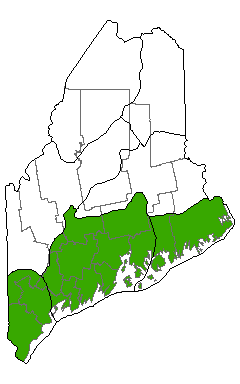
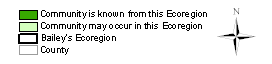
Distribution: Along Maine's immediate coastline and islands (Laurentian Mixed Forest Province). Landscape Pattern: Small Patch. Back to top.
Characteristic Plants: These plants are frequently found in this community type. Those with an asterisk are often diagnostic of this community.
- Sapling/Shrub
- Bayberry*
- Bush-honeysuckle*
- Meadowsweet*
- Poison-ivy*
- Red raspberry*
- Rugosa rose*
- Virginia rose*
- Winterberry holly*
- Dwarf Shrub
- Large cranberry*
- Lowbush blueberry*
- Herb
- Beach grass*
- Canaday mayflower*
- Greene's rush*
- New York aster
- Rough-stemmed goldenrod
- Sea-beach angelica
- Wire rush
- Yarrow
Examples on Conservation Lands You Can Visit
| Example | County |
|---|---|
| Little Duck Island | Hancock Co. |
| North Libby Island Wildlife Management Area | Washington Co. |
| Popham Beach State Park | Sagadahoc Co. |
| Sewall Beach, Bates Morse Mountain Conservation Area | Sagadahoc Co. |
| Stratton Island | York Co. |