
Join the MEA Mailing List Join the Alternative Assessment Mailing List Join the ESL Mailing List
When you subscribe to our mailing lists, you will receive periodic information from our coordinators as information becomes available.
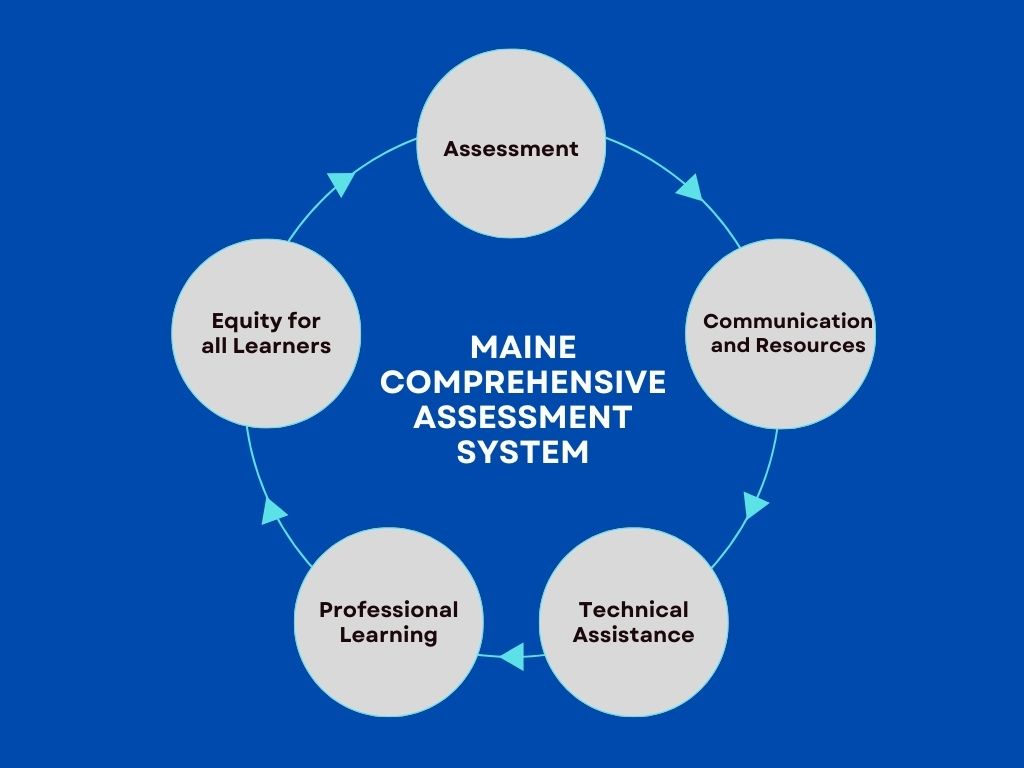
Assessing student learning is an essential aspect of education, as it provides data that can lead to improved instruction and outcomes. The Maine Comprehensive Assessment System (MECAS) provides information about the academic progress of students, schools, the state, and the nation as a whole. The MECAS includes state assessments, known as the Maine Educational Assessments, as well as national and international assessments.
Assessments take many forms, and each type of assessment has distinct value and purpose. In a balanced assessment system, state and national assessments are one “piece of the puzzle,” and the results are meant to be triangulated with multiple other data sources to provide a comprehensive picture of student learning at the state, district, school, and student levels. In Maine, state assessment data are also used to inform the state’s accountability model and determine where supports and resources are most needed. As a part of this collaborative process between Maine’s educators, schools, SAUs, and the Maine Department of Education, we continue to strive to ensure that every child has an equitable opportunity for success.
Questions about Maine Educational Assessments? Reach out to a member of the Team!
 New!
New!
May Monthly Update
April 2024 Office Hours
Slides and Q&A
Register for Office Hours!
Next Office Hours will be held on May 8th at 12:00 pm.
Contacts
| Jodi Bossio-Smith Director of Assessment Phone: 207-530-1462 Email: jodi.bossio-smith@maine.gov |
Krista Averill Assessment Coordinator Phone: 207-215-6528 Email: krista.averill@maine.gov |
Regina Lewis, Ph.D. NAEP & International Assessment Coordinator Phone: 207-530-1355 Email: regina.lewis@maine.gov |
|
Jodi Bossio-Smith |
Leah Jarvis |
Kalua Wilson |