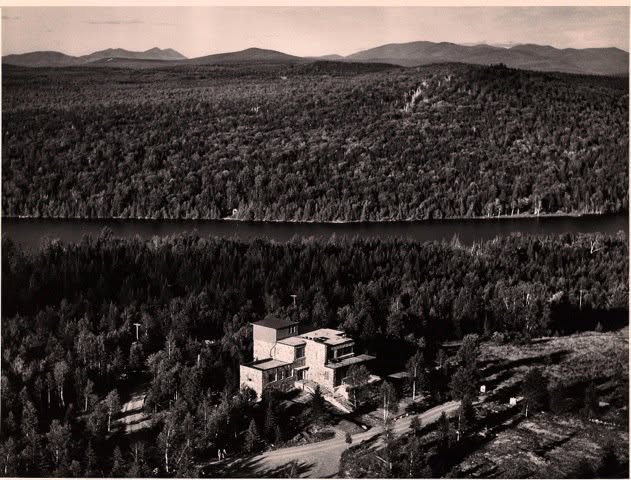
Wilhelm Reich Museum
Photo: Wilhelm Reich Museum.
Wilhelm Reich was a prominent Austrian medical doctor and psychoanalyst who trained under Sigmund Freud in Vienna. Following a tumultuous time in Europe, both personally and professionally, Reich immigrated to the United States, eventually buying a 280-acre property in Rangley in 1942. Reich named the property Orgonon, after a specific life energy called orgone that he studied. For Reich, Orgonon provided a pristine work environment to continue his studies. On the property, Reich built a Students Laboratory and the Orgone Energy Observatory, which included laboratory facilities, Reich's library and study, and outdoor decks for observing atmospheric phenomena.
Interestingly, as part of his research into cosmic orgone, Reich developed a "cloudbuster," an experimental apparatus meant to influence atmospheric orgone distribution, and through that, weather patterns. During the summer of 1953, facing drought conditions, local blueberry farmers asked Reich to intervene with his cloudbuster. Reich started his cloudbusting operation; rain began to fall within hours and continued for several days. The local press credited him for the rainfall that saved the blueberry crop.
In his will, Reich established the Wilhelm Reich Infant Trust Fund which was charged with maintaining the Orgonon as the Wilhelm Reich Museum. Located within the Orgone Energy Observatory, the museum is a Bauhaus-style building designed by James B. Bell and completed in 1948. Opening to the public in 1960, the museum preserves Reich's study, library, and scientific equipment almost exactly as they were at the time of his death in 1957.
The Wilhelm Reich Museum is listed on the National Register of Historic Places. Visitors to the museum can also enjoy over two miles of hiking trails on the property and explore the woodland beauty of the Rangeley Lakes region.