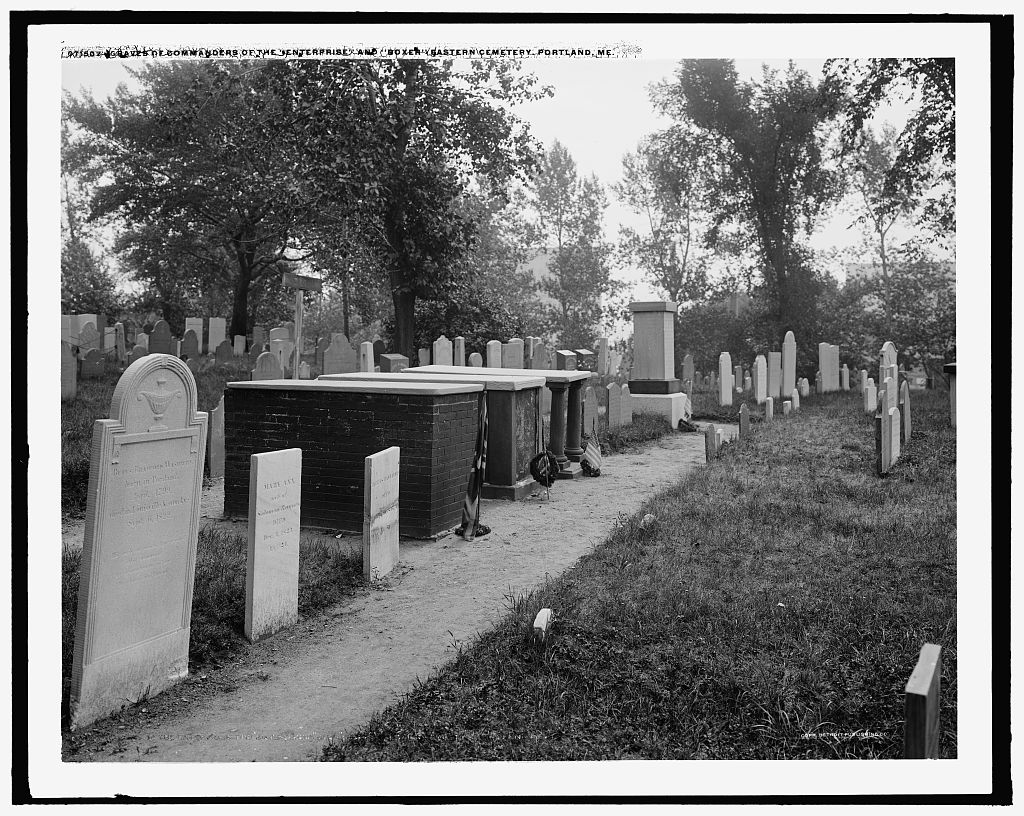
War of 1812
Enterprise and Boxer Drawing, Pen on Paper; By W.C. Dunn; 1817. Photo: Naval History and Heritage Command.
The immature and feisty United States declared war on Great Britain in 1812 because of disputes concerning British restrictions on American trade with Napoleonic France, the unauthorized and involuntary impressment of American sailors to serve in the British navy, and British support for Indigenous resistance against American settlement pressure. The war did not go particularly well for the United States, which was fortunate to be able to retain all its pre-war territories when the conflict was ended by the Treaty of Ghent in 1814.
During the war, Maine was part of the state of Massachusetts and was referred to as the District of Maine. The Federalist Party, which dominated Massachusetts, opposed the war because of substantial damage being done to maritime trade, and its participation in the hostilities was unenthusiastic and under-supported. When Maine was invaded by the British in 1814, the outright refusal of Massachusetts to offer military support to its beleaguered district's inhabitants became a factor in Maine's willingness to become an independent state through the Missouri Compromise of 1820.
The British invasion took advantage of Maine's weakness and Britain's growing strength as the defeat of Napoleon approached. The incursion was intended to create a permanent new colony, thought of as 'New Ireland,' adjacent to British Canada. With almost no resistance, British troops occupied the eastern third of Maine. Eastport was swiftly occupied and remained in British possession for years after the war; its whole citizenry took an oath of loyalty to the British crown. The Maine militia at Hampden fled almost without firing a shot. Bangor was briefly seized and thoroughly sacked. The entire militia of Washington County surrendered. A few hardier Mainers prepared to defend Portland, but the British, gorged with their plunder, stayed east of the Penobscot, enjoying their new territories and complacent subjects. With the peace settlement, everything was given back, eventually.
The Maine State Museum has a number of interesting objects related to the War of 1812. One is a musket, probably from an armed British commercial ship stripped of its contents to aid in the defense of Portland. Another is weirder.
In 1812 Spencer Thomas of Dixfield left his farm to join the American forces mustering to fight their traditional British enemy. In 1814 he found himself at the Battle of Lundy's Lane, near Niagara Falls, in the bloodiest encounter of the war. A musket shot struck him in the mouth. It destroyed seven of his teeth, split his tongue partly in two, and delivered him to the fortunate attention of a battlefield surgeon. Thomas lived, and for 200 years his dutiful family kept the bullet that hit him, and one of his broken teeth, in a box with letters describing his ordeal. The tooth was eventually lost, but the bullet and the letters survived, to be given to the museum in 2015: a most curious bit (bite?) of Maine history.