Wabanaki Basketmaking
Members of the Frey family, including Gabriel Frey, left, Francis "Gal" Frey, middle,and Jeremy Frye, right, Passamaquoddy basket makers, with some of their baskets. Photo: Penobscot Marine Museum.
In 2024, a Portland Museum of Art exhibit of baskets made by Passamaquoddy artist Jeremy Frey was the first-ever major retrospective of a Wabanaki artist in a fine art museum in the United States. It was a long time coming.
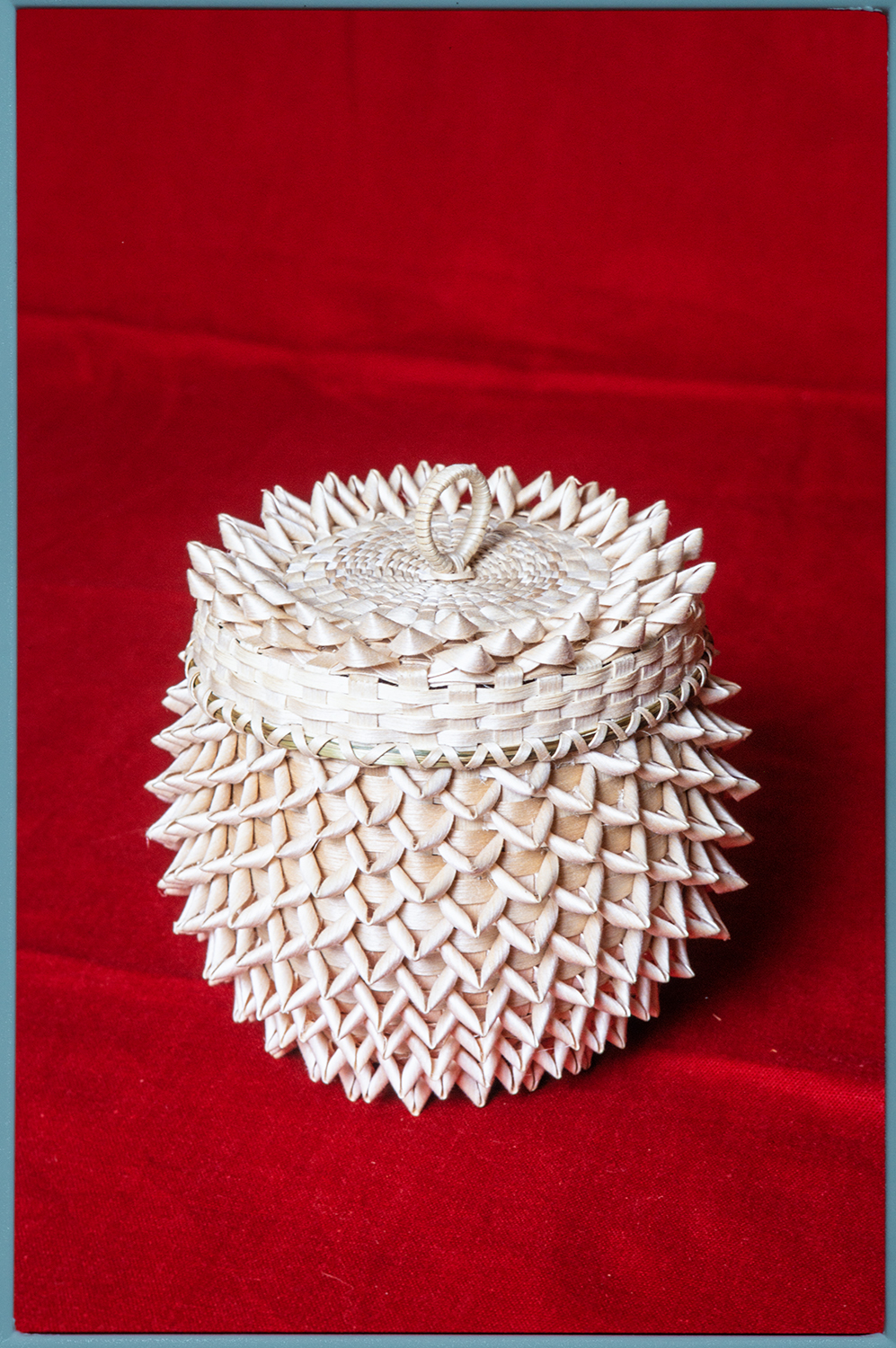
For millennia, the Wabanaki peoples have made baskets out of sweetgrass and brown ash splints. Woven by hand, these baskets traditionally were used for practical everyday purposes, such as food storage, fish trapping, and for transport. As tourists began arriving in Maine in the 1800s, Wabanaki basketmakers innovated, and a market developed for their “fancy” baskets. From the 1870s to the 1930s, these often highly ornamented and colorful baskets were in high demand from visitors to the state.
The Depression, World War II, and mass-produced plastic souvenirs sharply reduced the demand for Wabanaki-made baskets. As the end of the twentieth century approached, the tradition of basketmaking was in deep decline, with fewer people making the baskets and the traditional resources used to make them harder to find. But concerted efforts to save those traditions began.
In the early 1990s, a group of basketmakers from the Maliseet, Mi’kmaq, Passamaquoddy, and Penobscot tribes formed the Maine Indian Basketmakers Alliance and began offering intertribal workshops and apprenticeships for teaching and sharing the craft. The group also promoted the work through arts and basketry markets held throughout the state, including the popular Wabanaki Winter Market, New England’s largest holiday gathering of Wabanaki artists.
But as the basketmaking tradition revives, it faces more existential threats: climate change and a metallic-green beetle.
Crucial to making baskets is the brown ash tree. Known as “the basket tree,” the brown ash is deeply meaningful to the Wabanaki peoples beyond its role in basketmaking; in some of their creation stories, the Wabanaki peoples come into being by emerging through a split brown ash tree.
Today, these trees – and the other two native ash trees in Maine – are recognized by the state as critically endangered in Maine. Longer periods of drought and warmer winters that diminish the snow packs create conditions unfavorable to the moisture-loving tree, and since 2018, the emerald ash borer has been detected in 14 of the state’s 16 counties. An ash tree infested with the beetles’ larvae dies within three to five years.
Efforts to protect the state’s ash trees are underway. The Ash Protection Collaboration Across Waponahkik is a collection of tribal, state, federal, community, and academic collaborators spearheading a variety of initiatives aimed at educating the public, mapping and inventorying ash trees, and collecting seeds for seeding banking and regeneration.
The collaboration also connects Wabanaki basketmakers with landowners who have stands of healthy ash trees, helping ensure today’s artists – whose work is sought by collectors around the world – have the materials they need to carry the tradition forward.
Author: Stephanie Bouchard