For millennia, Wabanaki peoples have harvested Atlantic herring, once an abundant food source along the coast of Maine. When canning technology made preserving mass quantities of food cheap and effective, Maine, with its robust working waterfront infrastructure, was uniquely suited to become the center of the canned sardine industry.
From the nineteenth century through the mid-1900s, cans of Maine sardines – young Atlantic herring caught off the coast – were a staple of the American diet, found on dinner tables, in lunchboxes, in school cafeterias, at logging and sporting camps, and as military rations.
Many coastal communities had at least one cannery, and some, like Eastport, had dozens. But as tastes changed, the inexpensive cans of sardines that fed working families for generations became less popular. With demand dropping and management of the fishery tightening, the sardine canning factories began closing. The last sardine cannery in the United States – in Prospect Harbor – closed in 2010.
Throughout its history in Maine, the industry employed thousands, especially women, whose work at the canneries often complemented the labor of their male relatives in the fishing industry. While the shift-change whistles and the chatter of the factory machinery are silent now, the voices of some of those cannery workers have been preserved in oral histories.
Group of workers at Seacoast Canning Co., Factory #4, Eastport in 1911. Library of Congress.
Men on a dock in Friendship in 1940 packing sardines in barrels. Large chunks of ice are being broken up for refrigeration. Maine State Archives.
A worker wetting down herring in the hold of a sardine carrier, 1937. Maine State Archives.
Jeff and Justin Boyce moving dories in preparation for stop seine fishing for herring. Penobscot Marine Museum.
Sardine weir at Jonesport. Penobscot Marine Museum.
Maine Sardine Queen (and four unidentified men) posing in front of a giant (model) sardine can. Penobscot Marine Museum.
Women working on a packing line in Stonington Packing cannery. The sardine packers, all women, are working two per table under florecent lights. One of the women sports a Stonington Packing Co. hairnet. Penobscot Marine Museum.
Trays of freshly trimmed and packed Maine sardines in an unidentified cannery. Trimmed sardines were packed head to tail. Full cans were then sent to the saucing machine before being lidded and pressure cooked. Penobscot Marine Museum.
Rita Willey won 5 packing contests between 1970-1983. The packing contests were sponsored by the Maine Sardine Council to promote the sardine industry. Packers competed to see how many cans they could pack in 8 minutes. Penobscot Marine Museum.
This color print shows workers at Bumblebee Seafood posing in front of the Prospect Harbor cannery in June of 2010. This marked the end of a 135-year run for this facility as a sardine cannery. Penobscot Marine Museum.
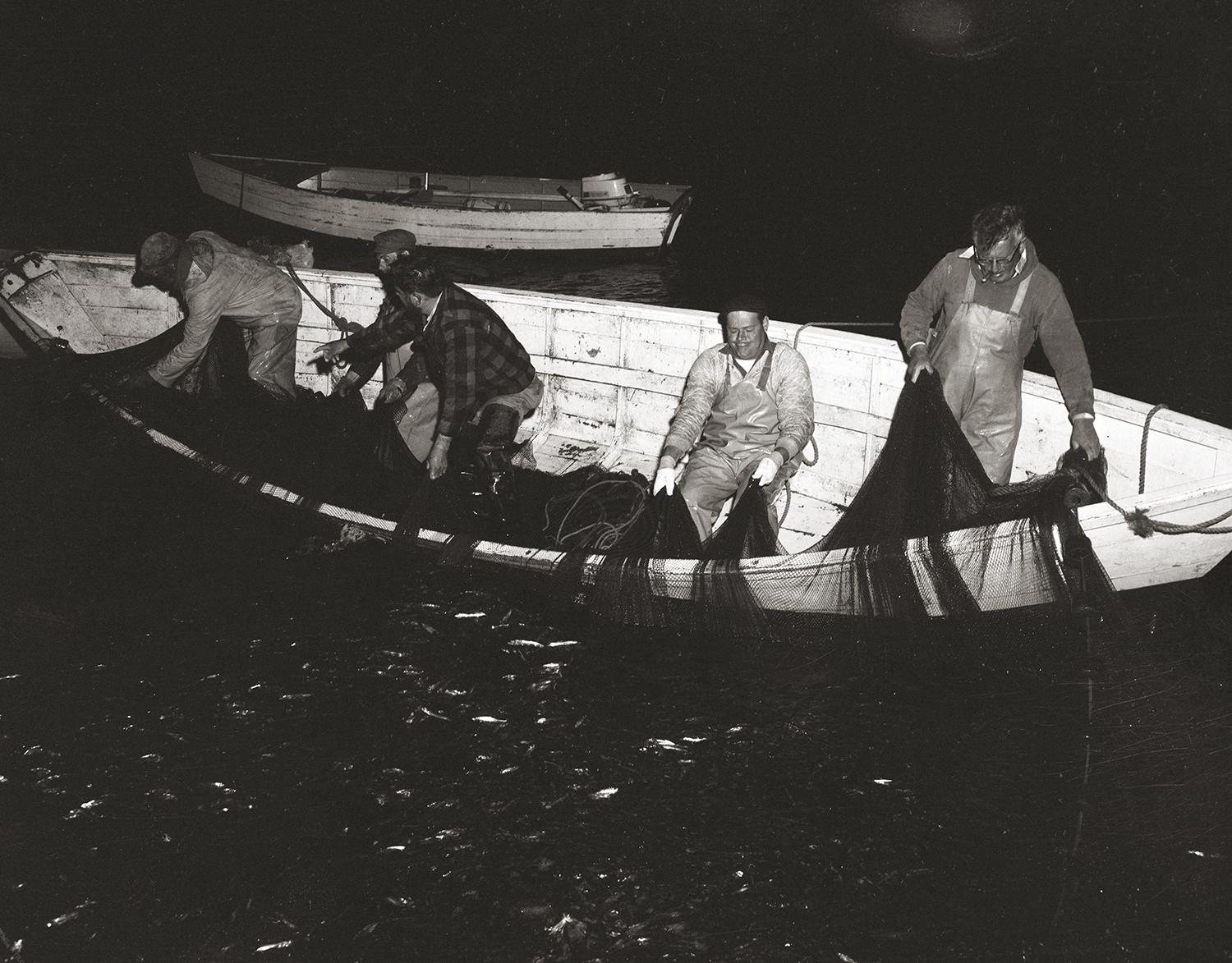
June 1962 Night shot with men and net full of sardines for sardine carriers. Penobscot Marine Museum.
A. B. Holt built Frenchman's Bay Packing Company on the shore of Bunker's Cove in South Gouldsboro in 1901. Penobscot Marine Museum.