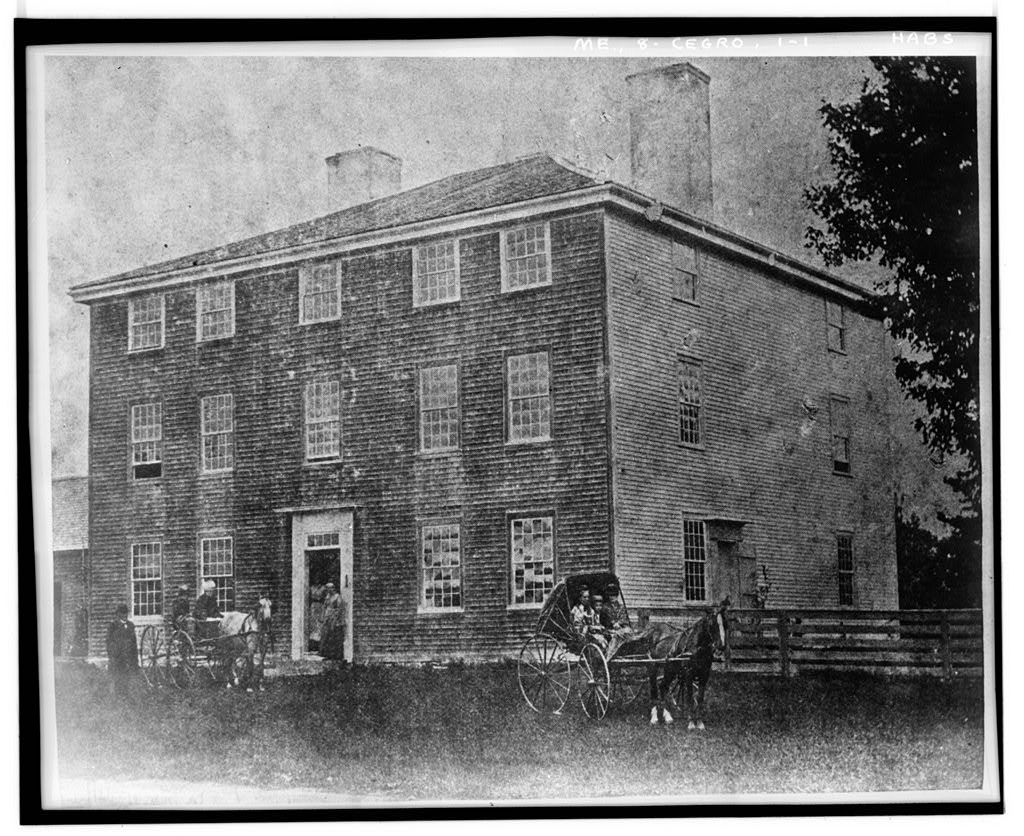
Pownalborough Courthouse
Photo: L'Mainerque on Wikicommons.
In the early years of John Adams's law career, he made a fateful journey to a courthouse on the banks of the Kennebec River in Dresden. Calling his first trip to Pownalborough Court House “a very unpleasant excursion,” the future president of the United States ultimately benefited from the miserable travel conditions when winning his case gained him a client that provided legal work for the next decade – and an agreement that most of his work for them would take place at the Falmouth Superior Court rather than at Pownalborough.
Built in 1761 for the newly created Lincoln County, Pownalborough Court House concurrently served as a tavern and the family home of Captain Samuel Goodwin. While most of the work at the courthouse was routine property disputes and county business, it had its share of scandalous cases, including the 1790 trial of Judge Joseph North on charges arising from the alleged assault of a local minister’s wife, a case chronicled in Laurel Thatcher Ulrich’s Pulitzer Prize-winning book, A Midwife’s Tale.
Although its role as a courthouse ended in the late eighteenth century, the building continued serving the public as a post office and gathering place until 1855. Captain Goodwin’s descendants lived there until 1930s and sold the courthouse in 1954 to the Lincoln County Historical Society, which operates it as a museum today. Listed on the National Register of Historic Places, it holds the distinction of being the only pre-Revolutionary courthouse still surviving in Maine today.
Author: Stephanie Bouchard