Passamaquoddy Wax Cylinder Recordings
Edison Gold Moulded Cylinder Record, ca. 1904
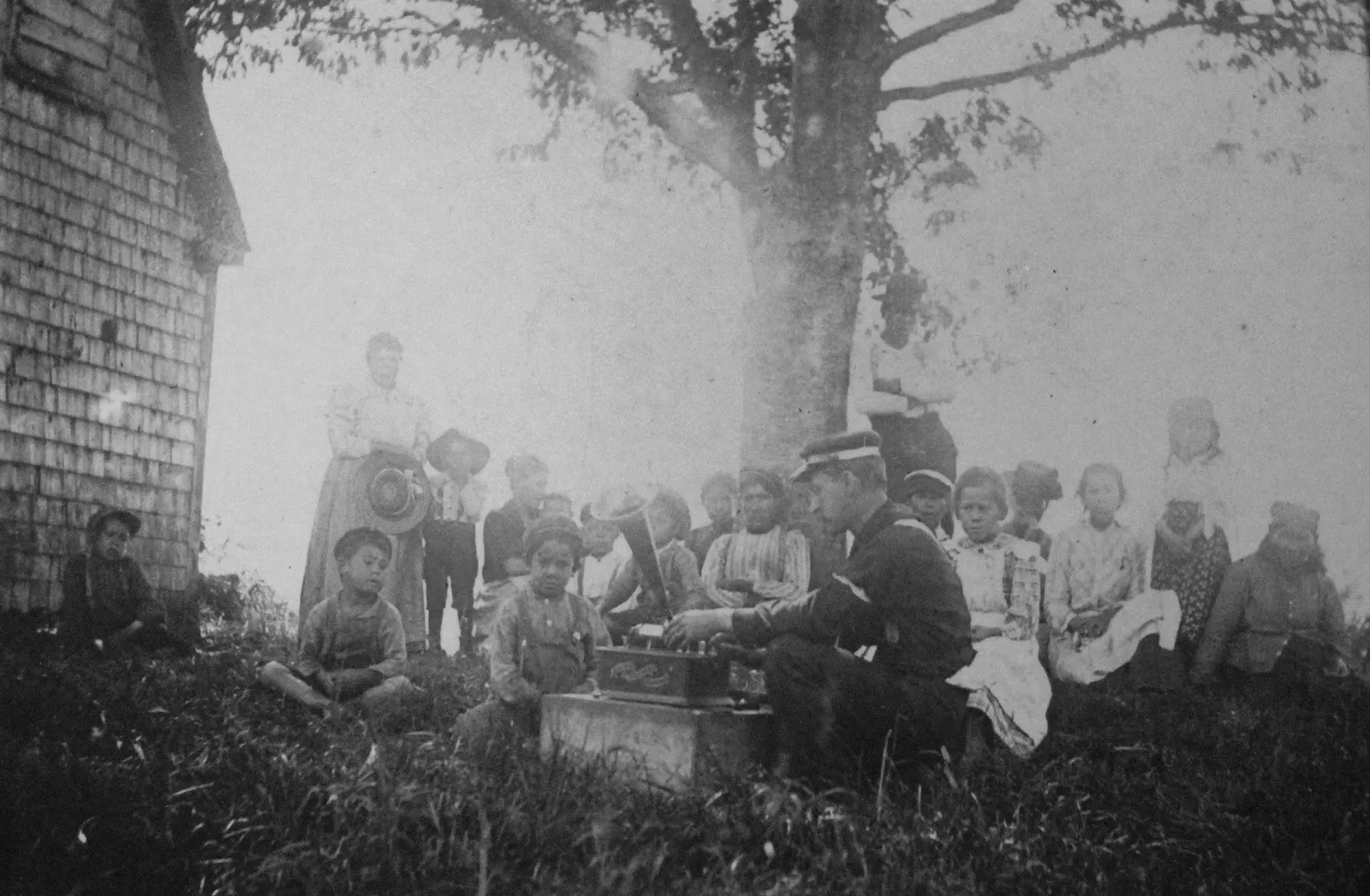
In March 1890 anthropologist Jesse Walter Fewkes journeyed to Calais and conducted one of the earliest experiments in ethnographic audio documentation in the world with the Passamaquoddy Tribe, one of the Indigenous communities in the region, comprising members from Sipayik and Motahkomikuk in Maine, as well as St. Andrews in New Brunswick, Canada.
During his visit, Fewkes tested a new wax cylinder phonograph, patented in 1878 by Thomas Edison. Over three days, he recorded thirty-six cylinders, capturing fragments of songs, legends, creation stories, and linguistic terms from Passamaquoddy community members, primarily Peter Selmore and Newell Josephs. Due to the cylinders' limited recording time of two to three minutes, only partial stories were preserved. Unfortunately, only thirty-one cylinders survive.
These recordings are the oldest known surviving ethnographic field recordings. At the time, war, disease, and broken treaties had reduced the tribe to just a few hundred members. Originally held at Harvard's Peabody Museum, the cylinders were donated to the Library of Congress in the 1970s. It wasn't until the 1980s that the Passamaquoddy learned about them, discovering that some sacred materials, including a funeral ceremony, had been publicly accessible for years. Now, as part of a digital repatriation initiative, the Passamaquoddy communities maintain curatorial control over the recordings.
Dwayne Tomah, a member of the Passamaquoddy Tribe from Sipayik and the youngest fluent speaker of the Passamaquoddy language, undertook the task of translating all the wax cylinder songs. Only about 12% of tribal members today are fluent speakers; widely shared within Passamaquoddy communities, these recordings serve as an important means of reconnecting them with their ancestral language and traditions.