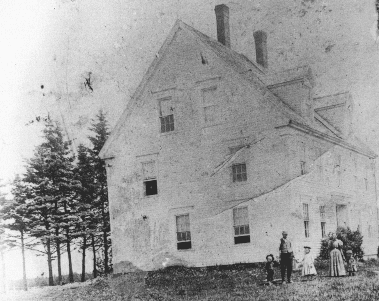
Olson House
Photo: Sarah Hansen
Overlooking the tidal marshes of the St. George River in Cushing sits what might be one of the most famous houses in Maine thanks to Andrew Wyeth. The Olson House still looks exactly as it did in Wyeth’s Christina’s World – and over 300 other works – its weathered, unpainted clapboards standing stark against the surrounding landscape.
The house itself predates its fame by nearly 150 years, constructed in 1806 by Captain Samuel Hathorn II. The third floor and steep roofline were added around 1871 by his grandson, when the family began renting rooms to summer visitors. By 1929 the property had passed to siblings Christina and Alvaro Olson, descendants of the Hathorns, who farmed the salt-sprayed land and took in occasional lodgers of their own. Christina had lived since childhood with an undiagnosed neuromuscular condition — later understood to be Charcot-Marie-Tooth disease — that robbed her of the use of her legs. Rather than using a wheelchair, she went around the house and grounds by crawling. Alvaro gave up fishing to work the farm and care for his sister after their parents died.
In the summer of 1939, a 22-year-old Andrew Wyeth was staying near his family's summer home in Port Clyde when a friend, Betsy James (later his wife) brought him to meet the Olsons. Wyeth was captivated, both by the spare architecture of the house and by the quiet endurance of the siblings who lived in it. He was given broad access to the property, including a small studio on the third floor, and returned nearly every summer for almost thirty years, until Christina and Alvaro died within a year of each other, in 1968 and 1967.
The house appears in many forms throughout Wyeth's body of work from this period, but it reached its widest audience through a single 1948 painting: Christina's World, which shows a woman (Christina) in a pink dress sprawled in a field, gazing up toward the gray farmhouse on the hill. The painting now hangs in the Museum of Modern Art in New York and remains one of the most reproduced images in twentieth-century American art.
The Farnsworth Art Museum in Rockland has owned and operated the Olson House since the 1990s. It was listed on the National Register of Historic Places in 1995 and designated a National Historic Landmark in 2011, in recognition of its singular role in American art history. While the house itself is currently closed due to necessary rehabilitation work, visitors can still visit the ground and marvel and the place that continues to inspire.