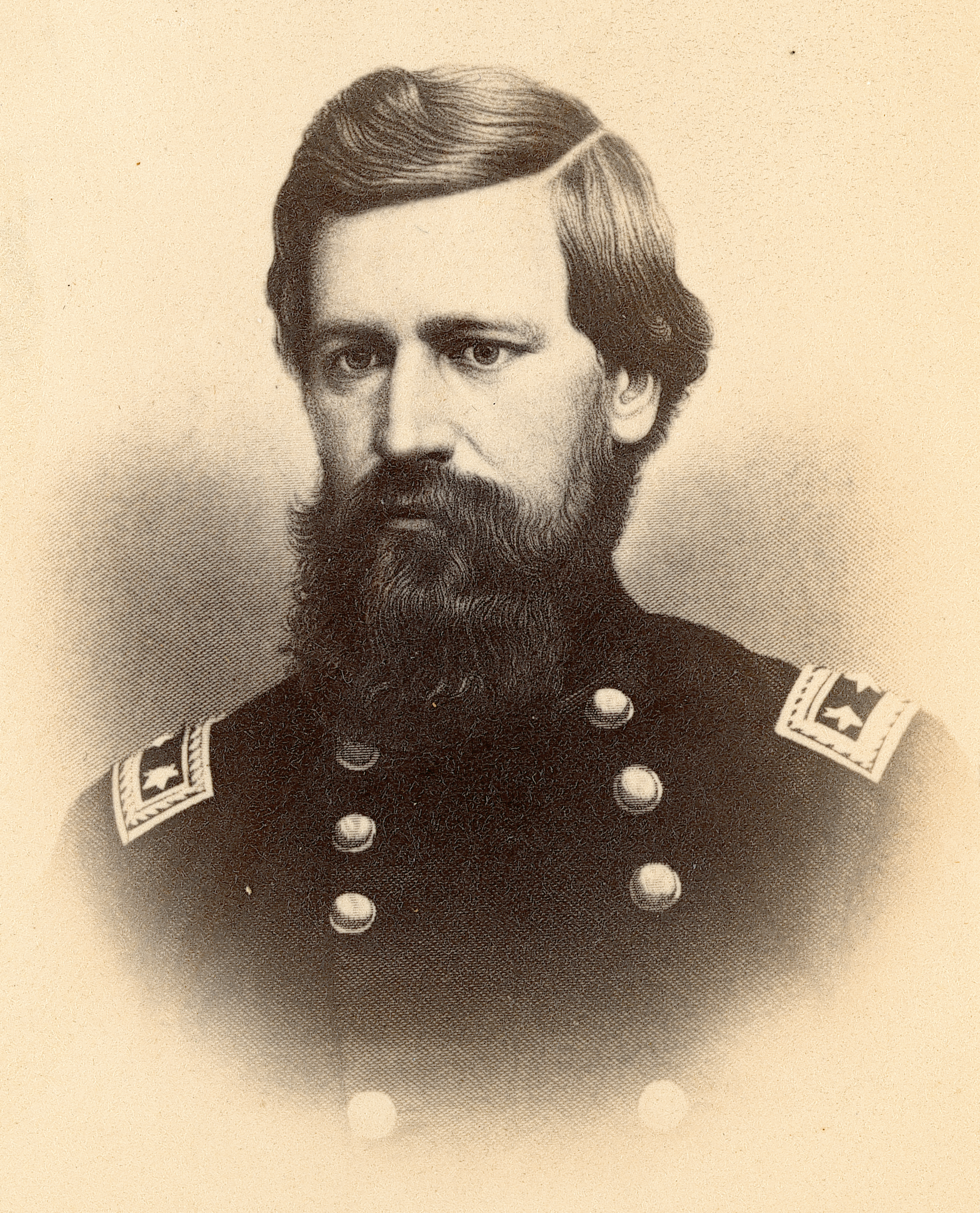
Oliver Otis Howard
Major General Oliver Otis Howard is standing at left. Photo: Library of Congress.
With the outbreak of the Civil War in early 1861, Oliver Otis Howard became the colonel of the Third Maine Regiment and rose to the rank of general by the end of the conflict. Born in Leeds in 1830, Howard attended Bowdoin College before enrolling at West Point Military Academy, where his abolitionist views alienated him from many of his classmates.
After the Union victory in 1865, General Howard was appointed commissioner of the Freedmen's Bureau, whose primary goal was to ensure that African Americans had access to land at education. They also aimed to provide basic necessities, such as food and clothing. This was a challenging task in the South, where many white individuals resented the U.S. military's presence. Legislatures in former Confederate states enacted a series of oppressive laws, known as the Black Codes, to hinder the political and social advancement of African Americans. Freedmen's Bureau workers and newly freed people often faced threats of racial violence.
The Freedmen's Bureau played a vital role in protecting black civil rights during a crucial political period. The Bureau's agents assisted in renegotiating labor contracts and, following the passage of the 14th and 15th Amendments, worked to enfranchise African Americans. As a result of the Bureau's schools, black literacy dramatically increased. However, in 1872 Congress shut down the Bureau due to the resurgence of Southern political power.
In 1867, General Howard helped found Howard University in Washington, D.C. The university, which included schools of law, theology, and medicine, did not exclude anyone based on race. He served as the university's president from 1869 to 1873.
Following his tenure at the university, General Howard represented the U.S. Army in Native American affairs. In 1872, he traveled to Arizona to negotiate a treaty with Cochise, the leader of the Chiricahua Apache. Howard successfully stopped the violence between Indigenous communities and white settlers. He then left his presidential position to take command of the Department of the Columbia in Oregon, where he oversaw the violent removal of the Nez Perce people from a small reservation in Idaho. In 1904, Howard retired from the army as a major general at the age of sixty-four, dying in 1909.