McIntire Garrison House
Photo: Library of Congress
Along a bend in the York River sits the McIntire Garrison, one of the most notable examples of a garrison-style house remaining in Maine. Micum McIntire, a Scottish highlander, arrived in York County in the 1660s after being deported from England for supporting the Scottish during the Third English Civil War. After landing in Massachusetts, he was sold as an indentured servant to the owner of a sawmill in New Hampshire. When his indenture came to an end, he made his way to Maine, getting land in York’s Scotland District in 1668. It was Micum’s son John McIntire who constructed the current house c. 1713.
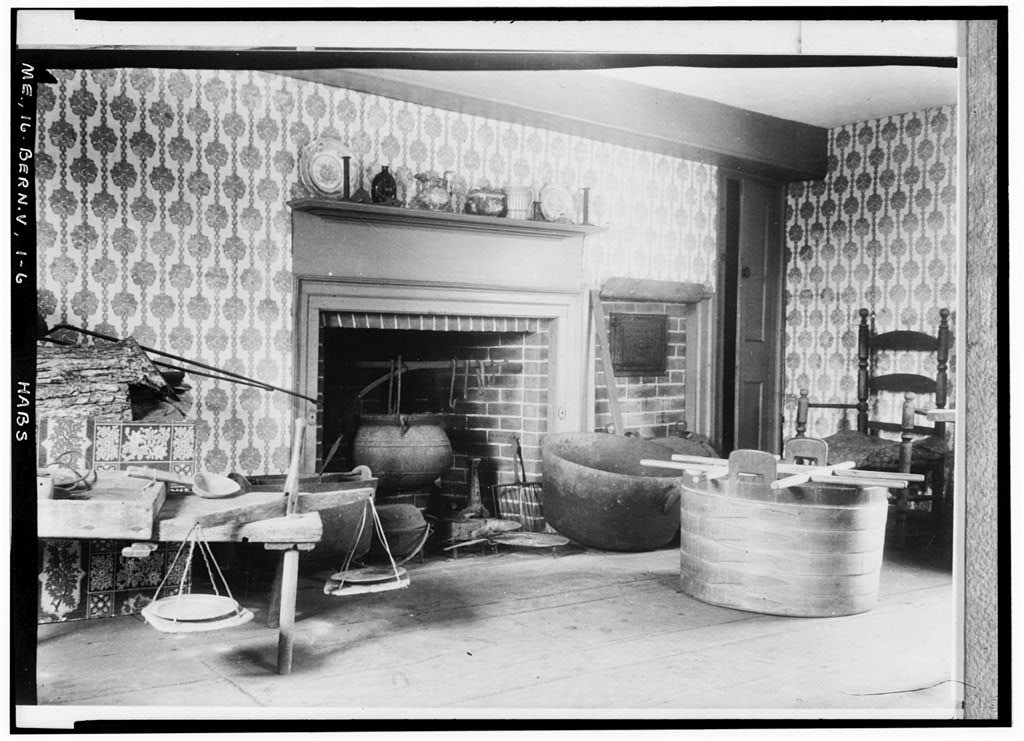
Built by European colonists to fortify their settlements against Indigenous people fighting to reclaim their lands, garrisons were relatively common in rural Maine. With an overhanging second floor and central chimney, the garrison is a log building covered with wood clapboard sidings along the long elevations and wood singles on the gable ends, all this cladding being added during a “restoration” in the early 20th century. The interiors of the building are largely unchanged from their original condition and are very plain.
Surrounded by 240 acres of farmland, the two-acre complex includes a carriage house, and a barn from 1808 known as the Cider House. The property, a National Historic Landmark, is now in the hands of the Old York Historical Society and will be a major source of information about life in colonial Maine.