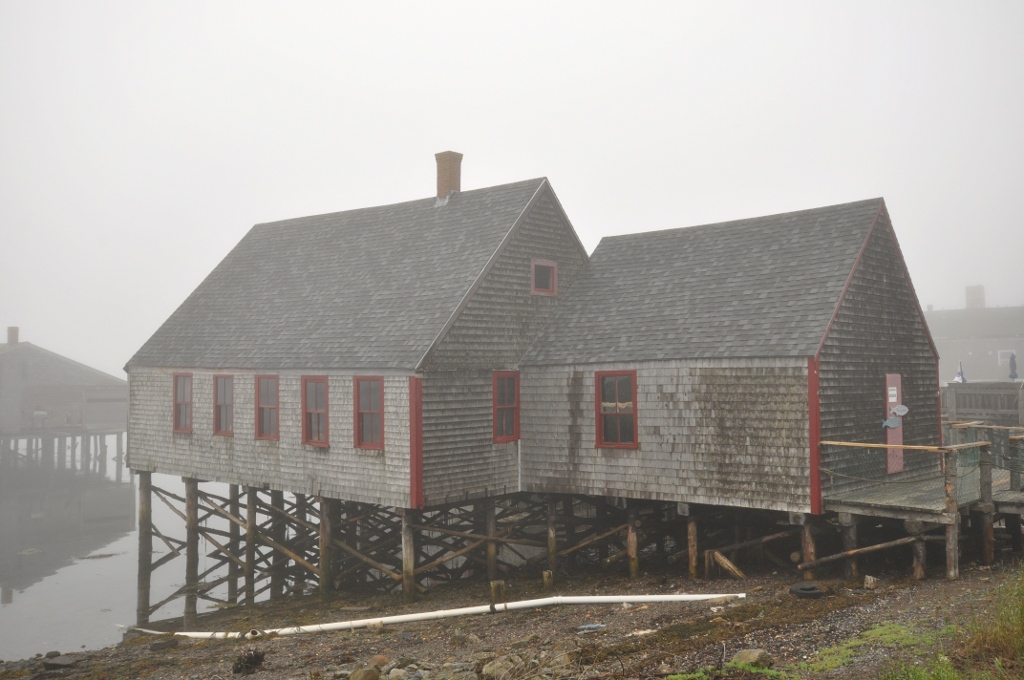
McCurdy Smokehouse
Photo: Sarah Hansen
During the peak of Lubec’s commercial herring industry, the waterfront was lined with dozens of sardine canning operations and smokehouses. By the mid-1970s, only one smokehouse remained in operation: McCurdy’s.
Long before canned sardines dominated the state’s fishing economy, Atlantic herring smoked along Maine’s waterfronts was in demand. While Wabanaki peoples harvested and smoked herring for preserving the fish, the smoking process used for industrial production beginning around 1800 came from European traditions.
Partially built on a pier, McCurdy’s began operating in the early 1900s. The number of buildings associated with the business expanded into a complex of connected structures. Each building served a specific function of the labor-intensive, highly choreographed process: from the catch’s arrival by boat, to the pickling shed where they soaked in brine, to the smokehouse itself where the fish were strung on long wooden sticks and hung from the rafters over a smoldering fire.
As the demand for smoked herring waned, McCurdy’s outlasted the others by several decades, until 1991, when it, too, ceased operations. Within a few short years, though, the smokehouse had another purpose: preserving the last intact traditional herring smokehouse complex in Maine. By the mid-1990s, a nonprofit organization formed and acquired McCurdy’s and in 2007, the skinning/packing shed opened as a museum where exhibits and tours are shaped by the firsthand experiences of former smokehouse employees. McCurdy’s is on the National Register of Historic Places and is open seasonally.
Author: Stephanie Bouchard