Maine State Museum & Collections
Moosehead Canoe. Paint-Decorated Wood-and-Canvas Canoe c. 1885. Photo: Maine State Museum.
The Maine State Museum was founded in 1836 and is Maine's largest and most comprehensive museum of state history and science. It contains some 800,000 objects representing almost every aspect of Maine's cultural history, geological history, archaeological history, and environmental history. It was first established by a kind of general subscription, through which members of the public were invited by letter to send to Augusta mineral and animal specimens they found to be of interest, in order to initiate a collection of scientific value. The letter even contained instructions on how to preserve dead animals that might be thought suitable; needless to say, no animal specimens were forwarded. But an initial geological collection was gathered and displayed, though it was ultimately dispersed and lost, as was a second collection. In the1890s the museum was established on a somewhat more stable basis, though it was closed and opened again several times before becoming an autonomous and permanent state agency in 1965.
The museum produces an ongoing wealth of educational programs, but its 40,000 sq. ft. of exhibits were closed in the 2020s for the major renovation of its building. The first exhibit sections will re-open with new displays in October 2026, to be followed by the rest of the exhibits as additional installations are built. The museum also manages historical displays in the State House and the Blaine House (the governor's residence).
Here are a few among the museum's innumerable objects that exemplify important aspects of Maine's history.
The Maine Penny
This is the only authentic Viking object ever found within the borders of the United States. Now a tiny, eroded coin the size of a dime, it was minted about 1080 A.D., during the reign of Olaf Kyrre (Olaf the Peaceful), who as a prince had survived a disastrous Norwegian invasion of England in 1066 and was allowed by the victorious English to return to his country after pledging lasting peace. This coin was found at the site of Brooklin, an important Indigenous trading depot, and almost certainly arrived there as a trade good or an object of personal adornment.
Maliseet Winter Coat Dating to about 1840
This is the only complete Indigenous workingman's outfit (called a capote, meaning hood, in French) known. It is a highly decorated example of a hooded winter coat made of blanketing, including leggings and moccasins, with exemplary porcupine quill embroidery and moose hair embellishments. It was probably fashioned by Maliseet women for a British surveyor involved in a border dispute between Maine and Canada.
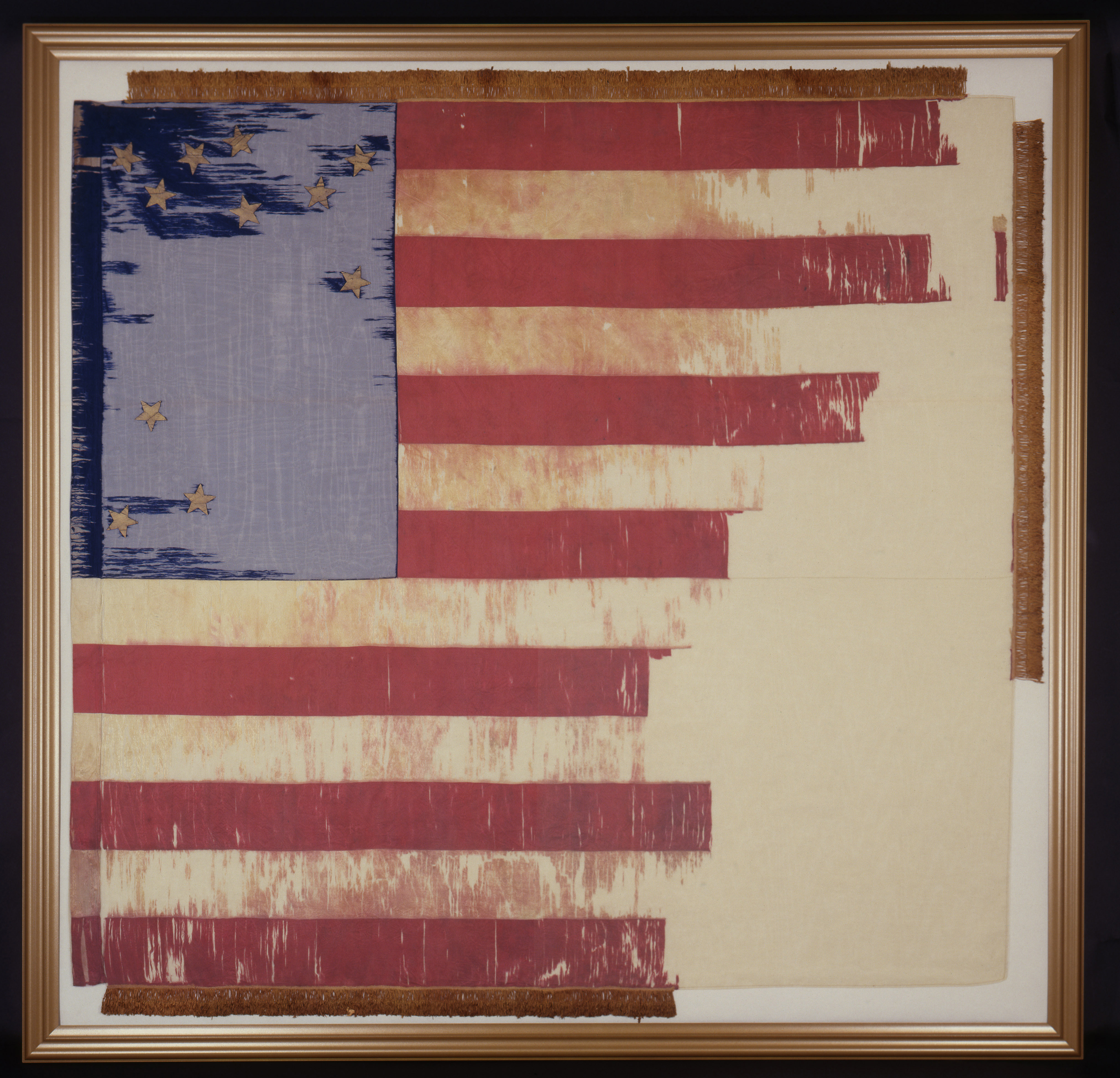
Battle Flag of the Twentieth Maine Regiment
The Civil War knows hardly any tale of heroism greater than Maine's 20th Regiment's defense of Little Round Top on July 2nd, 1863, at the Battle of Gettysburg. Under Colonel Joshua Chamberlain the brave boys of Maine defended the exposed, extreme left wing of the federal defenses and repulsed waves of Confederate attacks, the success of any one of which might have resulted in the outflanking of the whole Union army and a defeat fatal to the survival of a free and united country. This flag, shredded by bullets and souvenir hunters, is a poignant symbol of Maine's contribution to the Union cause. The museum also owns a pistol personally captured by Chamberlain from a Confederate officer at the climax of the fight.
Moosehead Lake Canoe
This canoe, dating to the 1870s, is likely the earliest surviving wood-and-canvas canoe in Maine. Original Native birch bark-and-wood canoes were highly prized by visitors in the 19th century, who could buy examples at the Indian commercial 'encampments' located at major tourist sites such as Bar Harbor and Kineo House on Moosehead Lake. Canvas replaced birch bark as part of the commercialization of manufacturing, allowing many more people to acquire canoes. The elaborate hunting scenes painted on this canoe, applied at some point after its initial use, include a view of the Kineo House hotel, suggesting that it may have been displayed at that famous establishment.
Source: A Story of Maine in 112 Objects, Bernard Fishman, ed. (Maine State Museum)