Maine Railroads
The steam locomotive Lion, built in Boston by Hinkley & Drury, 1846. Photo: Maine State Museum.
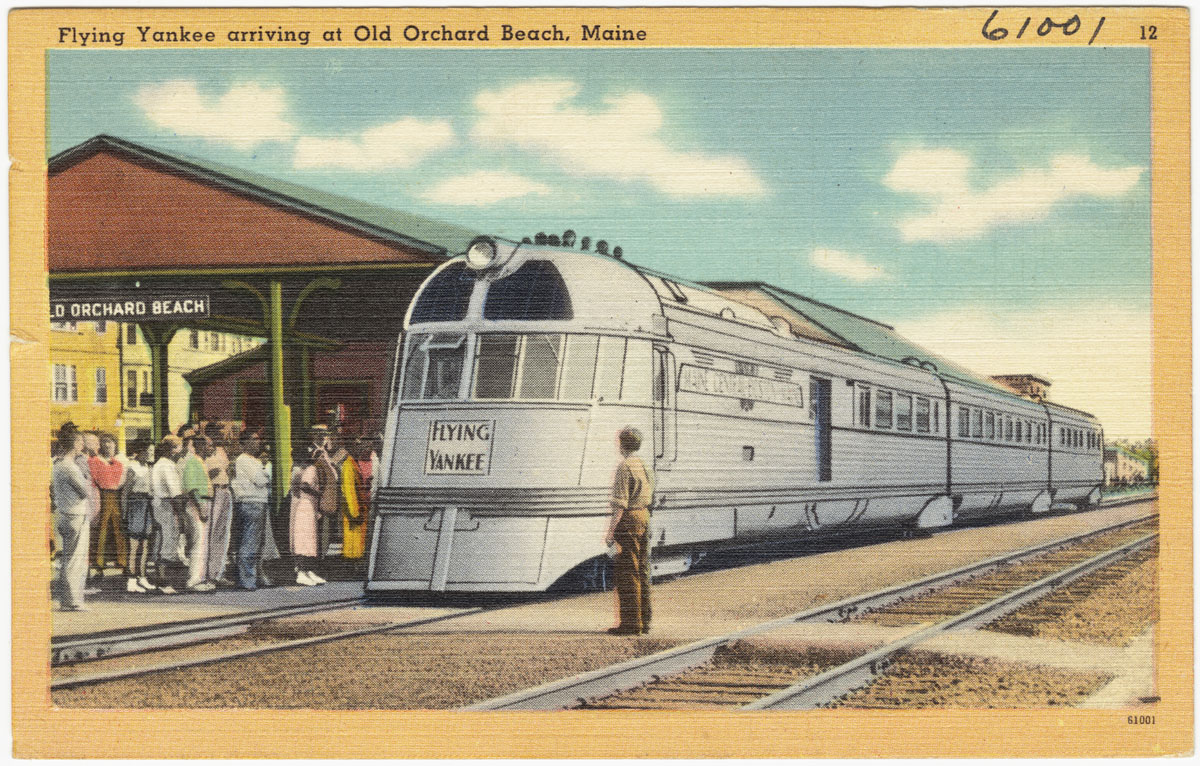
Maine's rail story starts in 1836, when the Bangor and Piscataquis Canal and Railroad opened twelve miles of track between Bangor and Old Town to haul timber — the state's first line. Through the rest of the 1800s, three companies came to dominate: Maine Central, the Boston & Maine, and the Bangor & Aroostook (formed 1891), which together connected mill towns, ports, and farms, and opened the state to tourism as vacationers rode the rails to new coastal and mountain resorts.
Maine's oddest contribution was the two-foot narrow gauge — an unusually tight track width, borrowed from Welsh mountain railways, used to reach small towns tucked into rocky, forested terrain that standard gauge couldn't easily serve. It earned Maine the nickname "Realm of the Two-Footers."
One of Maine's earliest railroad stories survives in a single object at the Maine State Museum: the steam locomotive Lion.
Built in Boston by Hinkley & Drury in 1846, Lion operated on the standard gauge Whitneyville and Machiasport Railroad in Washington County, the second oldest railroad in Maine. Running on early strap rail track, the wood burning locomotive hauled lumber from the mills in Whitneyville to schooners waiting at Machiasport for nearly fifty years. Its service illustrates the close relationship between Maine's forests, mills, and coastal trade while preserving a rare example of mid nineteenth century American locomotive design. Today, Lion remains one of the museum's best known transportation artifacts. Restored in a rich olive green, a color chosen because green was common on American locomotives of the period, it reflects the best historical interpretation available, although the locomotive's original paint color is unknown.
Although Maine's railroad network eventually grew to include extensive standard gauge systems and the state's celebrated two-foot gauge railways, Lion represents an earlier chapter in that history. More than a locomotive, it is a surviving link to the technology, craftsmanship, and industrial ambition that helped shape Maine. Lion continues to tell the story of how railroads connected Maine's people, industries, and coast through innovation and hard work.