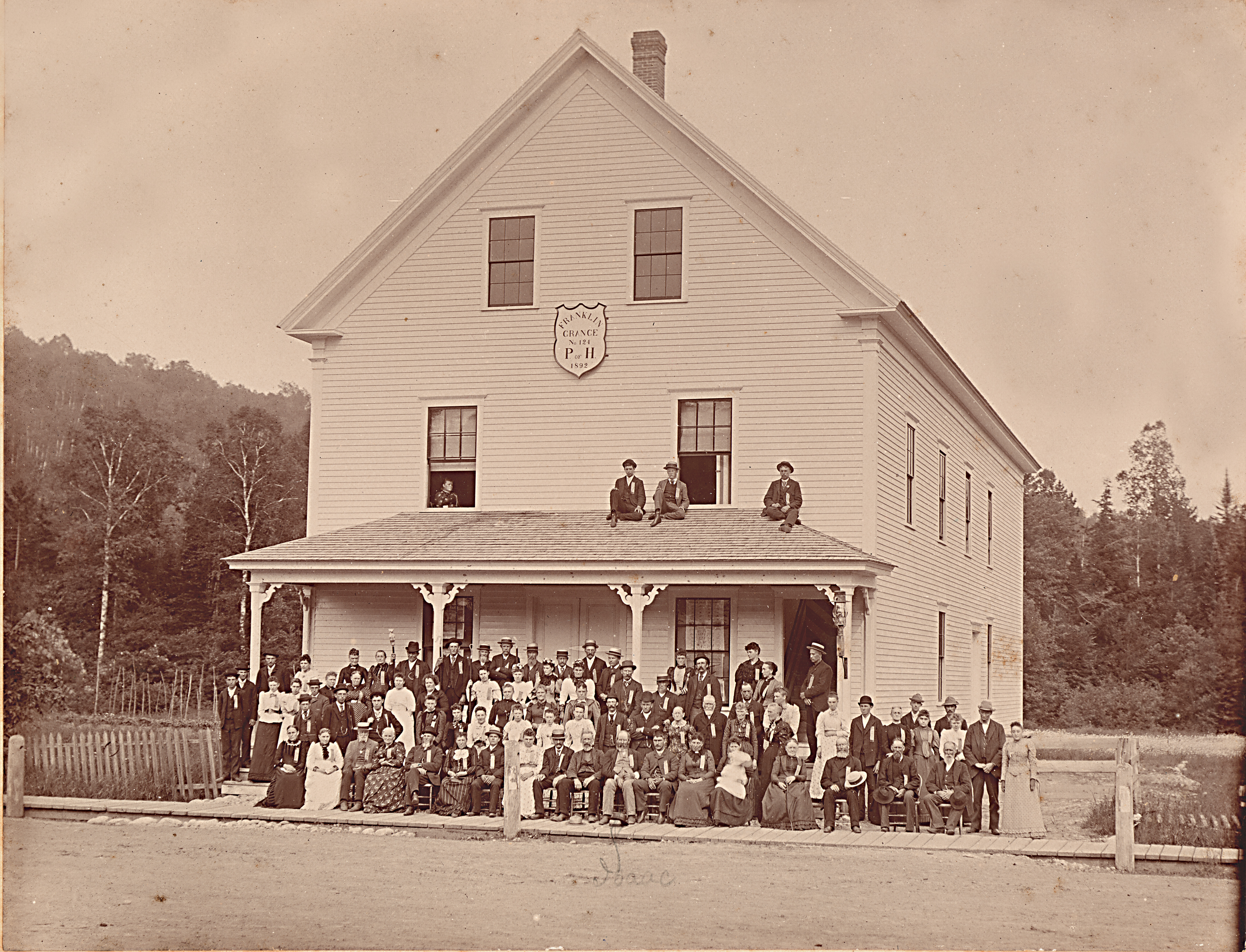
Grange Halls
Houlton Grange Hall and Grange Store dedication in 1904. Photo: Collections of Aroostook County Historical and Art Museum.
The National Grange of the Order of Patrons of Husbandry, better known as the Grange, continues to be a significant part of Maine's community life.
The Grange was founded as a national organization in 1867, and the first Grange in Maine was organized in Lewiston in 1874. The organization spread quickly, expanding to 228 Granges within two years, with approximately 12,000 members. By 1907, Grange membership in Maine was larger per capita than in any other state. At one point, Houlton Grange No. 16 was the largest in the world!
The Grange created a more centralized version of the farmers' clubs that had existed throughout much of the 19th century, providing a place where farmers could organize, share ideas, and advocate for themselves. The Grange worked on behalf of the communities it served, supporting education, local schools, libraries, the University of Maine System, Cooperative Extension, and 4-H clubs.
The Grange was also a vocal supporter of issues affecting rural communities. Over its more than 150-year history, this advocacy has taken many forms, including promoting railroad and banking regulation and group purchasing in the 1870s and 1880s; supporting direct primary elections, recall and referendum processes, women's suffrage, and limits on monopolies at the turn of the 20th century. More recently, Grange's have encouraged improved science-based farming and household management methods, and distributing food, clothing, and supplies after disasters.
More than an organization, the Grange was a physical gathering place. In some small communities, Grange halls were the only public spaces available for residents to meet, functioning as community centers where people gathered for educational programs, dances, potlucks, town meetings, political rallies, and other events.
Twenty-one Grange halls in Maine are listed on the National Register of Historic Places, and many continue to play an active role as gathering places for community activities.