Franklin Simmons
A photograph of the plaster model for the Army Group of the Portland Soldiers and Sailors Monument was taken in Franklin Simmons' sculpture studio in Rome, Italy, in about 1890. Photo: Maine Historical Society
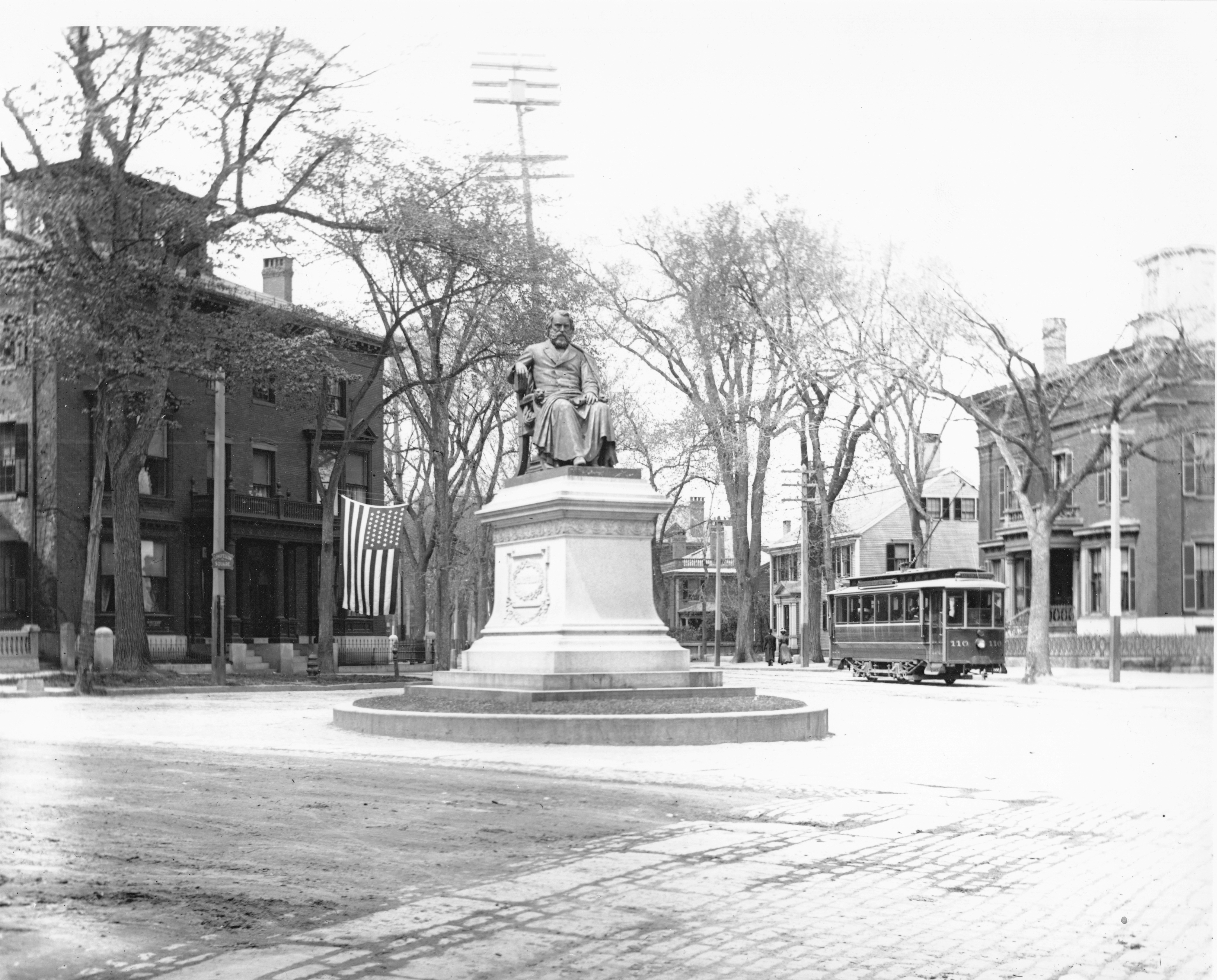
In downtown Portland you can admire the 1888 Henry Wadsworth Longfellow statue in Longfellow Square, then meander down Congress Street and marvel at the 1891 Sailors and Soldiers Monument in Monument Square – both part of the extraordinary sculptural legacy of Franklin Simmons.
Born in what is now Sabattus and raised in Bath, Simmons’ family ended up in Lewiston when he was 16 years old. He attended Bates College (then the Maine State Seminary), but his meager finances did not allow him to continue. By 1858, with very little formal training or education, Simmons opened his own art studio and began to paint and sculpt using clay he obtained from the banks of the Androscoggin River.
By the start of the Civil War, Simmons had received numerous commissions and developed a reputation as a great sculptor. After a brief move to Portland, Simmons was asked to bring his talents south to Washington, D.C. Here he modeled 24 portrait medallions of President Abraham Lincoln, the presidential Cabinet, and various generals and admirals. He also carved marble statues of Governor William King of Maine, General Grant, and Roger Williams of Rhode Island – all of which you can still see today in the Capitol rotunda. Locally, you can see the Franklin Simmons collection at the Portland Museum of Art.
In 1868 Simmons left the US for Rome, where, with the exception of a few visits back home to Maine, he lived until his death in 1913. Over the course of his lifetime, Simmons created hundreds of sculptures and is remembered as one of the most prominent and prolific sculptors in America.