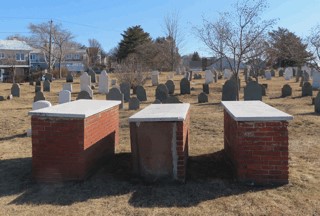
Eastern Cemetery
Spirits Alive
Ship captains, political leaders, veterans of the Revolutionary War, family members of poet Henry Wadsworth Longfellow and Black abolitionist Reuben Ruby, and hundreds of residents who watched Portland (then called Falmouth) burn during the British bombardment of October 1775 are a few of the estimated 7,000 buried in Portland’s Eastern Cemetery.
Established in 1668, the roughly seven-acre Eastern Cemetery sits on a slope at the base of Munjoy Hill overlooking Casco Bay. It is the area’s oldest public burial ground and is on the National Register of Historic Places. Originally, only the southeastern half was used for burials and the remainder served public uses: It was a training ground for the local militia and it was here that they mustered in 1775 to march to Cambridge to join George Washington and his troops.
Over the centuries it was actively used, the burials expanded into various segregated sections for Quakers, Catholics, Black people, and “Strangers,” with the last interments taking place in the mid-1800s.
Decades of neglect left the cemetery overgrown and vandalized, with many stones broken, toppled over, or sunken. Various restoration efforts took place during the mid-twentieth century, but a consistent community-led effort began in 2006 with the formation of the nonprofit Spirits Alive. This all-volunteer organization has made the cemetery as much a space for the living as the dead. In addition to its restoration and conservation efforts of the landscape and graves, it leads a variety of walking tours in the cemetery, including its popular “spooky” tours in October. The group’s efforts have made the cemetery not just a historic memorial, but a popular spot for walking, birding, and even picnicking.
Author: Stephanie Bouchard