Aroostook War
Calais Frontier Guard banner, 1939. Maine Historical Society.
During peace treaty talks in Paris that would resolve the American Revolution, representatives for the United States and Britain defined the eastern U.S.–Canada border in such a confusing way that where exactly the border between Maine and Canada was became an ongoing dispute. That dispute flared up during the mid- to late-1830s when Maine began a census of the upper Aroostook River territory and St. John River region.
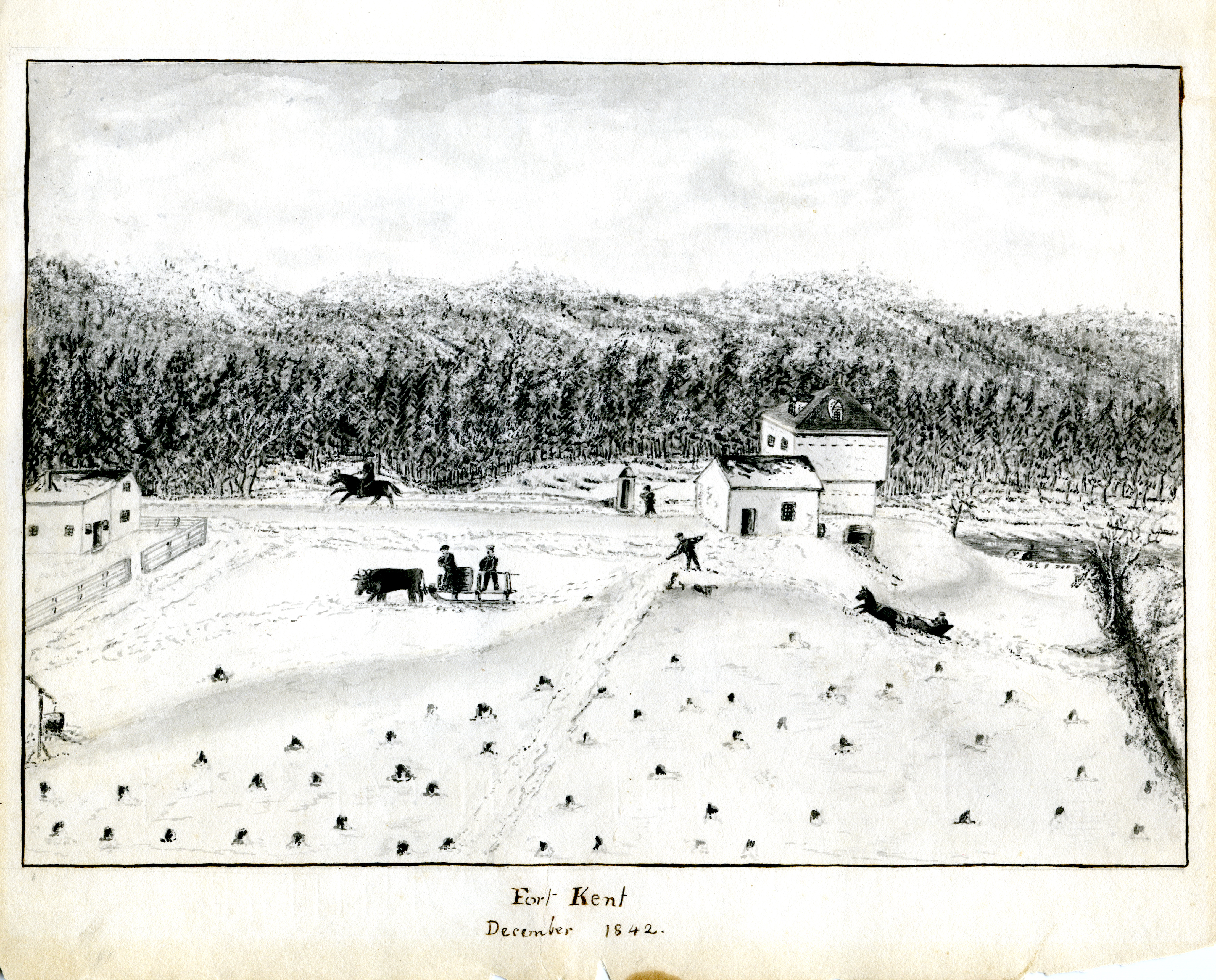
Called the Aroostook War, the Madawaska War, and the Pork and Beans War (so-called because of the diet eaten by those involved) no actual military battles occurred. Instead, during the “bloodless war” militias mobilized, arrests were made, forts were built (see Fort Kent Blockhouse), and good deal of frontier brinkmanship unfolded, especially over valuable timberland.
As things escalated between the governors of Maine and New Brunswick and the lumberjacks in the disputed area, the governments of Britain and the United States stepped in, wanting to avoid an international incident. In 1842 they reached a compromise, the Webster–Ashburton Treaty, which settled the Maine–Canada–New Brunswick boundary and the boundaries between British North America and New Hampshire, Michigan, and what later became Minnesota.
Out of the confusion and tension of the Aroostook War emerged Aroostook County itself – “the County” to Mainers today – created in 1839 as Maine worked to solidify its hold on the disputed region.
Author: Stephanie Bouchard