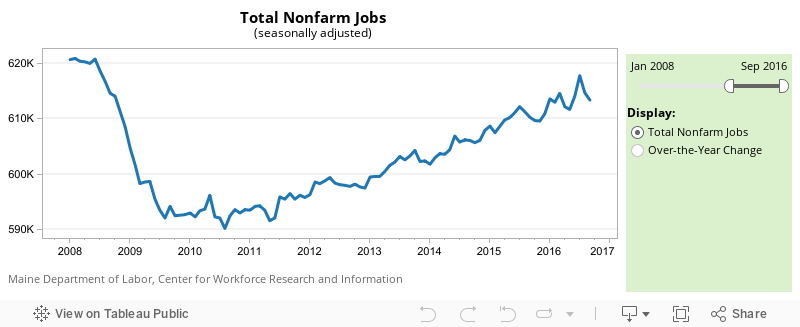
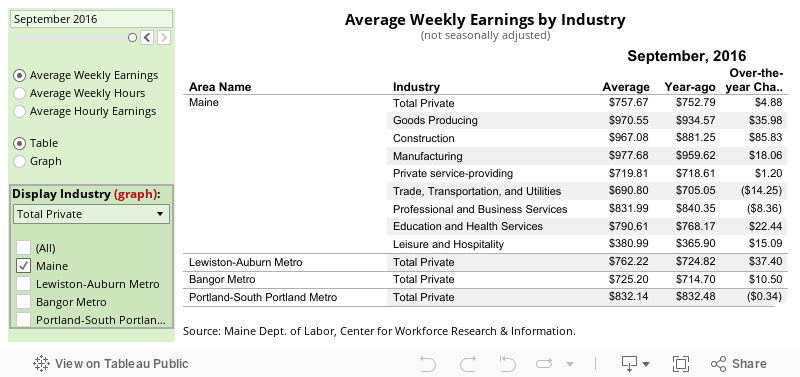
Nonfarm Payroll Job Estimates
Data is derived from the Current Employment Statistics (CES) program. CES is a federal-state cooperative statistical program to estimate current employment in a state or sub-state area. A statistically valid sample of employers is surveyed to supply total number of employees, total number of female employees, total number of production workers, total number of hours worked, and total wages earned. This survey is the basis of current estimates of these characteristics. It is used in the calculation of the monthly estimates of employed, unemployed, and the unemployment rate.
Tables
Nonfarm wage and salary employment estimates are subject to revision the month after they are published and at the end of the year.
| April 2013 | March 2013 | April 2012 | Net Change |
Percent Change |
|||
|---|---|---|---|---|---|---|---|
| Over the Month | Over the Year | Over the Month | Over the Year | ||||
| Maine | 597.4 | 597.8 | 598.9 | -0.4 | -1.5 | -0.1% | -0.3% |
| U.S. | 135,474 | 135,309 | 133,397 | 165 | 2,077 | 0.1% | 1.6% |
Latest News Release | Data Release Schedule
Seasonally Adjusted
- Nonfarm Payroll Job Estimates by Industry for Maine and the Bangor, Lewiston-Auburn and Portland-Biddeford MSAs
(
Interactive) (Excel)
- Nonfarm Wage and Salary Employment for Maine and the Bangor, Lewiston-Auburn and Portland-Biddeford MSAs (Excel)
- Which Industries are Growing in Maine? (
Interactive) - Net Job Change in Maine for the Last 7 Recessions (
Interactive)
Not Seasonally Adjusted
- Nonfarm Payroll Job Estimates by Industry for Maine and the Bangor, Lewiston-Auburn and Portland-Biddeford MSAs
(
Interactive) (Excel) - Nonfarm Wage and Salary Employment by Place of Work for Maine and the Bangor, Lewiston-Auburn and Portland-Biddeford MSAs (Excel)
Historical Data and Charts
Detailed Industry Employment (1990–2012)
Detailed Total Nonfarm Employment (1939–2012) (Excel)
Hours and Earnings
- Maine and the Bangor, Lewiston-Auburn and Portland-Biddeford MSAs (Excel)
Historical Data and Charts
Statewide | Bangor, Lewiston-Auburn and Portland-Biddeford MSAs
Links
- Current Employment Statistics (CES) - United States Bureau of Labor Statistics
- North American Industry Classification System (NAICS)
FAQs
- What is the difference between seasonally adjusted and not seasonally adjusted data?
Most economic series, including employment and unemployment data, are affected by seasonal variations. Often it is difficult to tell from raw statistics whether developments between any two months reflect changing economic conditions or merely normal seasonal fluctuations. In order to compare employment and unemployment data for any pair of months accurately, a statistical technique known as seasonal adjustment is used.
- What is the difference between nonfarm employment and labor force employment?
Nonfarm employment is estimated based on the Current Employment Statistics (CES) survey of business establishments, and represents a count of jobs by place of work. Labor force employment is based largely on a household survey, the Current Population Survey (CPS), and represents employed persons by place of residence.
- What is the CES definition of employment?
CES employment is an estimate of the number of nonfarm, payroll jobs in the U.S. economy. Employment is the total number of persons on establishment payrolls employed full- or part-time who received pay for any part of the pay period that includes the 12th day of the month. Temporary and intermittent employees are included, as are any employees who are on paid sick leave, on paid holiday, or who work during only part of the specified pay period. A striking employee who only works a small portion of the survey period, and is paid, would be included as employed under the CES definitions. Persons on the payroll of more than one establishment are counted in each establishment. Data exclude proprietors, self-employed, unpaid family or volunteer workers, farm workers, and domestic workers. Persons on layoff the entire pay period, on leave without pay, on strike for the entire period, or who have a pending job but have not yet reported for work are not counted as employed. Government employment covers only civilian employees; it excludes uniformed members of the armed services.
- What is a benchmark?
The benchmark adjustment, a standard part of the payroll survey estimation process, is a once-a-year re-anchoring of the sample-based employment estimates to full population counts available principally through unemployment insurance (UI) tax records filed by employers with State labor market information agencies. The difference between the March population counts and the March sample-based employment estimates is referred to as the benchmark revision. A preliminary estimate of the benchmark revision is published in late September, and the final benchmark revision is published with the January preliminary estimates in early February.
Contact Information
Maine Department of Labor
Center for Workforce Research & Information
118 SHS
Augusta, ME 04333-0118
Phone: (207) 623-7900
TTY: Maine Relay 711
Email: CWRI.DOL@Maine.gov